


The spindle moulder is a particularly versatile woodworking machine that can be used for a wide range of joinery and cabinetmaking operations, including mouldings, grooves, rebates, joints, profiling and tenoning.
However, the quality and variety of machining operations depend directly on the choice of tooling fitted to the machine.
With universal cutter blocks featuring interchangeable knives, carbide insert tooling, different bore diameters and various knife heights available, choosing the right model is not always straightforward.
Whether you are a woodworking enthusiast or a professional joiner, this guide explains the main criteria to consider when choosing a cutter block suitable for your spindle moulder and woodworking applications.
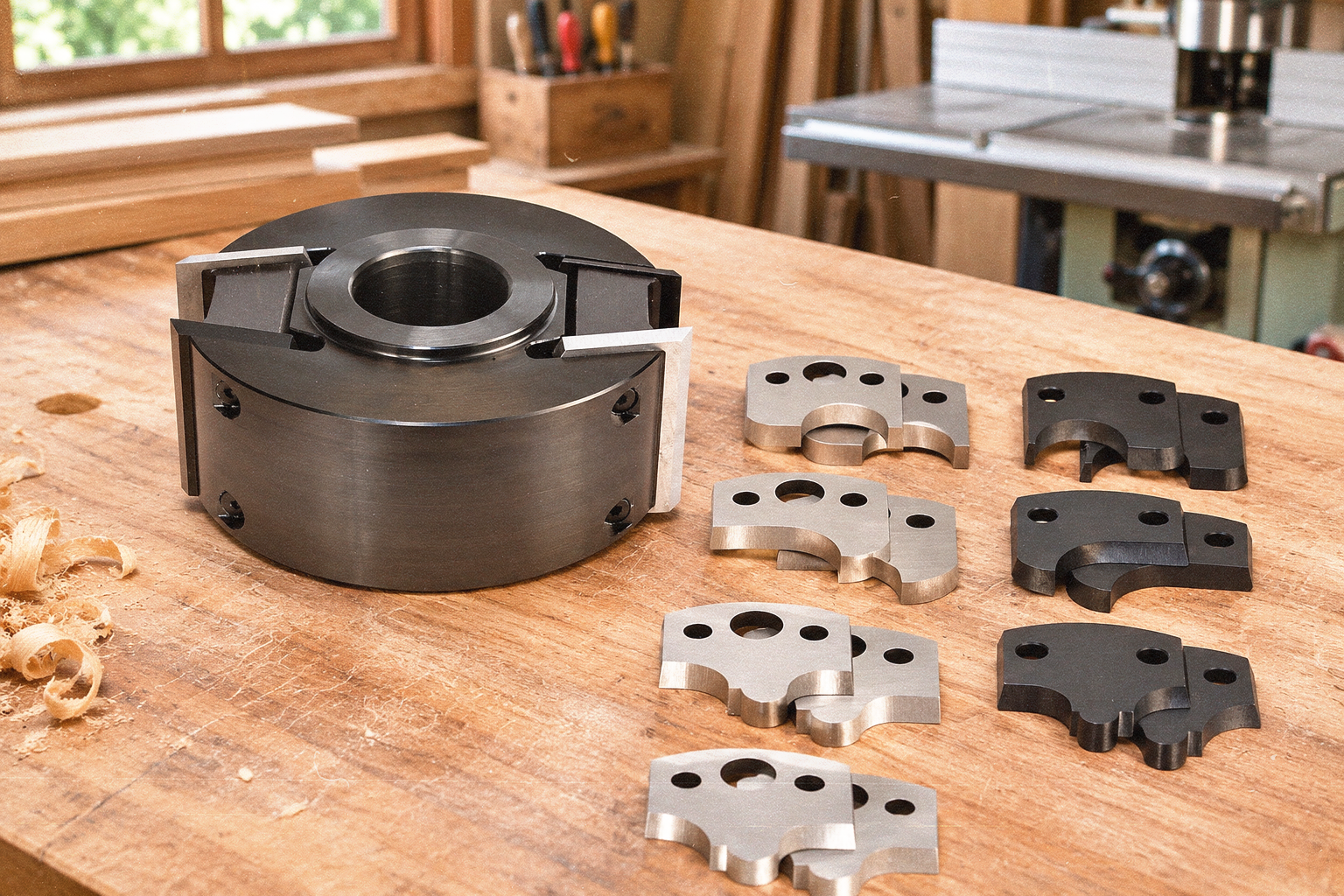
A universal cutter block with interchangeable knives allows numerous profiles to be produced using a single tool body.
1. What is a spindle moulder cutter block?
A spindle moulder cutter block is a rotating cutting tool mounted on the spindle of the machine. Depending on its design, it accommodates knives, cutters or cutting inserts used for machining wood.
Unlike a circular saw blade, which is primarily used to cut and separate material, a cutter block allows the shape of a workpiece to be modified by producing different profiles.
It can be used for:
-
Producing decorative mouldings.
-
Machining grooves and tongues.
-
Producing rebates.
-
Rounding or chamfering timber edges.
-
Producing profile and counter-profile joints.
-
Producing certain types of tenons.
-
Profiling furniture components.
The choice of cutter block therefore depends primarily on the result you wish to achieve.
Discover our comprehensive range of spindle moulder tooling, suitable for a wide variety of joinery and cabinetmaking applications.
2. What are the different types of spindle moulder cutter blocks?
There are several types of spindle moulder tooling, each designed to meet specific woodworking requirements.
Universal cutter blocks with interchangeable knives
The universal cutter block, also known as a multi-purpose cutter block, is particularly useful for woodworkers who wish to produce a wide variety of profiles without investing in a complete cutting tool for each machining operation.
It generally consists of a metal body that accommodates interchangeable profile knives and, depending on its design, the corresponding limiters.
By changing the knives, it is possible to produce different mouldings, rebates, rounded shapes and decorative profiles.
It is an economical and versatile solution, particularly suitable for workshops carrying out a variety of woodworking operations.
Rebating cutter blocks
A rebating cutter block is used to produce a rectangular recess along the edge of a timber workpiece.
Rebates are commonly used in the manufacture of:
-
Frames.
-
Doors and windows.
-
Furniture back panels.
-
Joinery joints.
-
Recesses designed to accommodate panels or glazing.
Some models are equipped with carbide inserts and scoring spurs to improve the cleanliness and quality of the rebate edges.
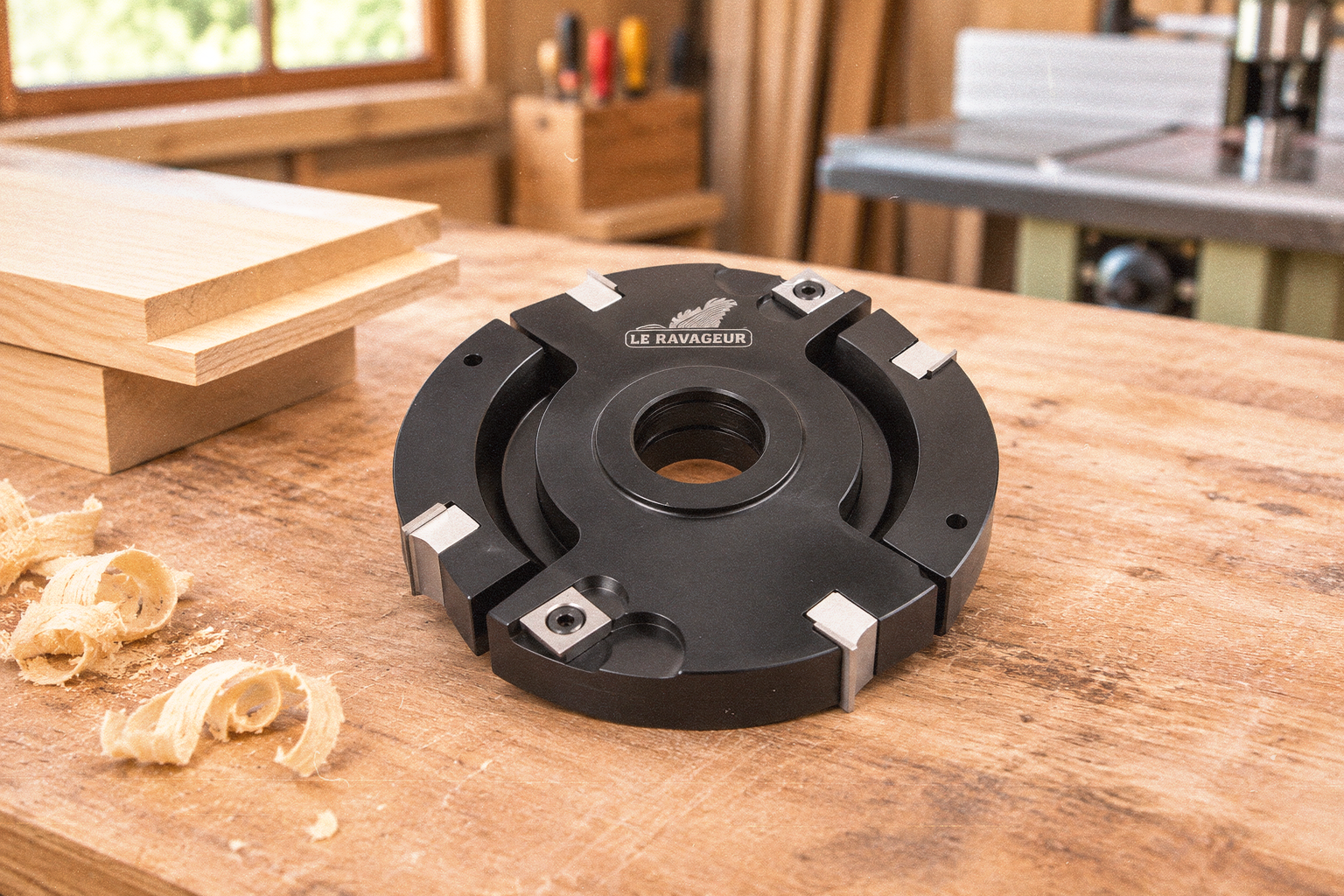
A rebating cutter block allows precise rectangular recesses to be machined along the edges of timber workpieces.
Grooving cutters
A grooving cutter is used to produce a groove in a timber workpiece, particularly to accommodate a panel, tongue or joint component.
Both fixed-width grooving cutters and adjustable grooving cutters are available.
Adjustable models allow the groove width to be modified within the limits specified by the manufacturer, generally using dedicated spacer rings.
Grooving cutters may be equipped with brazed carbide cutting tips or replaceable carbide inserts.
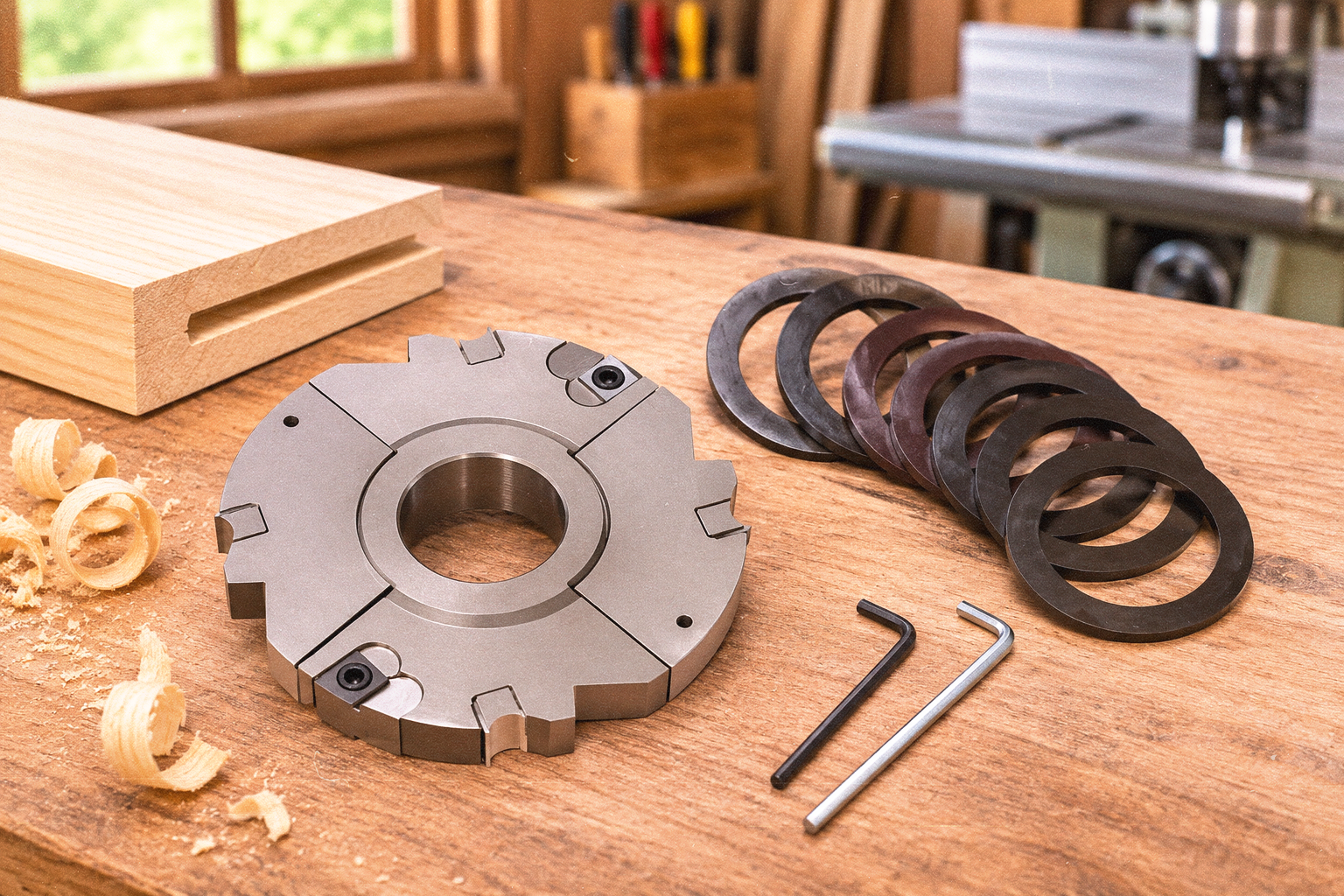
An adjustable grooving cutter allows the groove width to be adapted to the dimensions of the joint being produced.
Profile and counter-profile cutters
Profile and counter-profile cutters are primarily used in the manufacture of cabinet doors, frames and assembled panels.
They allow two complementary machining operations to be carried out so that the different components fit together correctly.
These cutters are particularly popular in the manufacture of kitchens, furniture and cupboard doors.
Raised panel cutters
Raised panel cutters are used to machine the edges of a panel, creating a decorative profile and a thinner outer section designed to fit into a grooved frame.
They are commonly used in the manufacture of solid wood cabinet doors.
As these tools can have a relatively large diameter, particular attention must be paid to machine compatibility and the permitted rotational speed.
3. How do you choose the correct cutter block bore diameter?
The bore diameter corresponds to the diameter of the central hole in the cutter block, allowing it to be mounted on the spindle of the machine.
It is one of the first technical specifications to check before purchasing a cutter block.
Common bore diameters include:
-
20 mm.
-
25 mm.
-
30 mm.
-
35 mm.
-
40 mm.
-
50 mm.
The 30 mm bore is particularly common on spindle moulders used in woodworking workshops and on European combination woodworking machines. A 50 mm bore is also used on certain professional machines.
However, not all machines have the same spindle diameter.
Can a reducing bush be used?
Certain reducing bushes allow a cutting tool with a larger bore to be fitted onto a machine spindle with a smaller diameter.
This adaptation is only possible if it is authorised by both the tool manufacturer and the machine manufacturer, using a reducing bush specifically designed for this purpose.
It is essential to comply with the requirements for centring, mounting and securely clamping the assembly.
Warning: never attempt to mount a cutter block with an incompatible bore using an improvised reducing bush or a homemade modification. Spindle spacer rings must not be confused with bore reducing bushes.
4. What is the difference between 40 mm and 50 mm spindle moulder knives?
Universal cutter blocks are available to accommodate knives of different heights, including 40 mm and 50 mm models.
These dimensions correspond to the nominal height of the knives and not necessarily to the maximum height of the profile that can be produced.
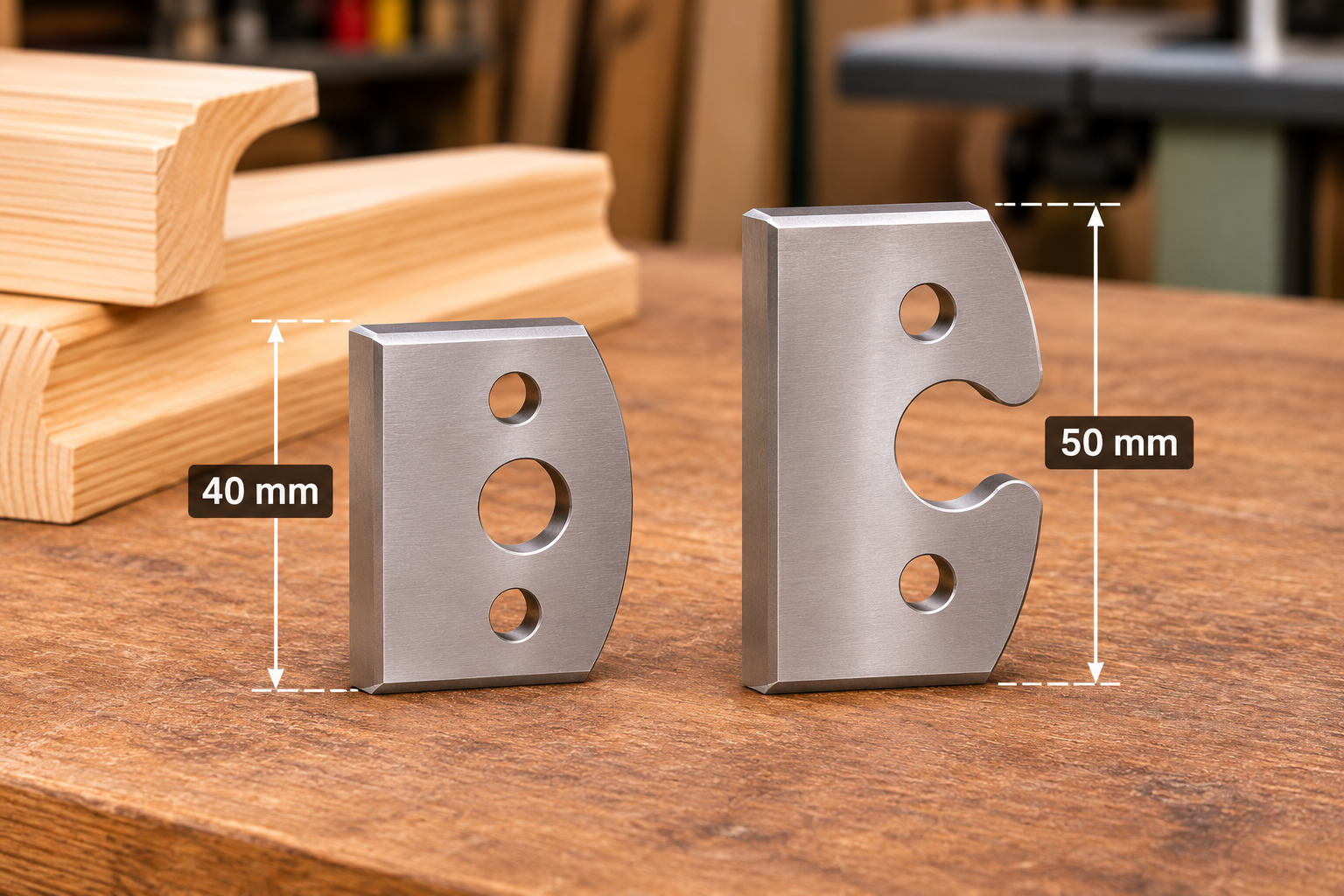
Knife height is an important selection criterion, but it alone does not guarantee compatibility with a cutter block.
40 mm spindle moulder knives
40 mm knives are suitable for a wide range of everyday joinery applications.
They can be used to produce:
-
Decorative mouldings.
-
Rounded profiles.
-
Chamfers.
-
Small profiles.
-
Certain rebates.
-
Jointing profiles.
They are generally an excellent choice for users looking for a versatile solution for everyday woodworking operations.
Discover our selection of 40 mm spindle moulder knives and limiters for producing a wide variety of decorative profiles and woodworking joints.
50 mm spindle moulder knives
Depending on their profile, 50 mm knives allow taller profiles or larger mouldings to be produced.
They are particularly useful for certain furniture-making applications, decorative joinery and profiling timber workpieces with a larger cross-section.
Are 40 mm and 50 mm knives interchangeable?
Not necessarily.
Some standard 50 mm cutter blocks can also accommodate 40 mm knives, provided they are compatible.
However, certain 50 mm safety cutter blocks cannot accommodate 40 mm knives due to differences in knife thickness.
The centre-to-centre distance between the locating holes is also an essential criterion. Some knives have a hole spacing of 24 mm, while others have a spacing of 30 mm.
Before purchasing, check:
-
The permitted knife height.
-
The knife thickness.
-
The centre-to-centre distance between the locating holes.
-
The fixing system.
-
The compatibility of the limiters.
-
The part numbers recommended by the manufacturer.
Remember: two knives of the same height are not necessarily compatible with the same cutter block.
5. What is the purpose of limiters on a spindle moulder cutter block?
A limiter, also known as a chip thickness limiter, is an essential component of certain cutter blocks designed for manual feed operations.
Unlike the knife, which has a cutting edge, the limiter is designed to restrict the amount of material that can be engaged by the cutting edge.
It therefore helps reduce the risk of excessive material removal and workpiece kickback.
The profile of the limiter must correspond to the profile of the knife being used, in accordance with the manufacturer's specifications.
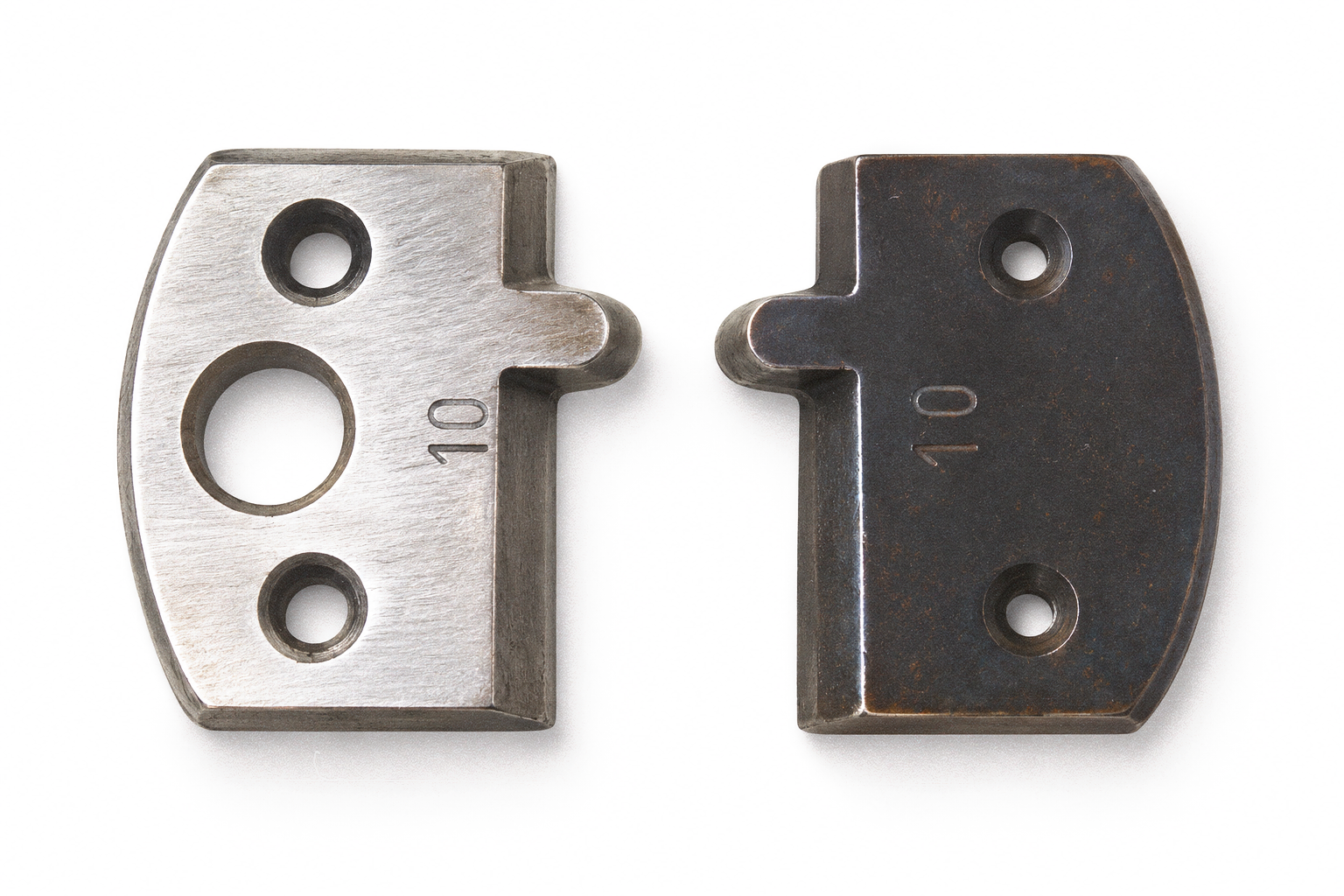
The knife cuts the wood, while the limiter restricts the amount of material engaged by the cutting edge. Their profiles must be compatible.
Do limiters need to be changed when replacing the knives?
On a cutter block that uses profiled limiters, the limiters corresponding to the new knives must be fitted.
Knives and limiters with different profiles must never be combined arbitrarily.
When purchasing a set of knives, check whether you have a standard two-knife cutter block or a safety cutter block requiring two knives and two limiters.
Important: limiters do not replace spindle moulder guards, workpiece holding devices or the need to observe the correct feed direction.
6. Interchangeable knife or carbide insert cutter blocks: which should you choose?
The choice depends primarily on the type of work, the materials being machined and the frequency of use.
Cutter blocks with interchangeable knives
These cutter blocks offer the advantage of allowing numerous profiles to be produced using the same tool body.
Their main benefits are their versatility and the generally lower cost of changing profiles.
They are particularly suitable for:
-
Versatile joinery workshops.
-
Woodworking enthusiasts.
-
Occasional moulding operations.
-
Producing a variety of decorative profiles.
Cutter blocks with carbide inserts
Carbide insert cutter blocks are often designed for a specific machining operation, such as rebating, sizing or grooving.
Carbide generally offers good wear resistance, particularly when machining hardwoods and certain wood-based panels.
On models equipped with reversible inserts, the inserts can be rotated when one cutting edge becomes worn, provided the manufacturer's instructions are followed.
This provides a fresh cutting edge without having to replace the entire cutter block.
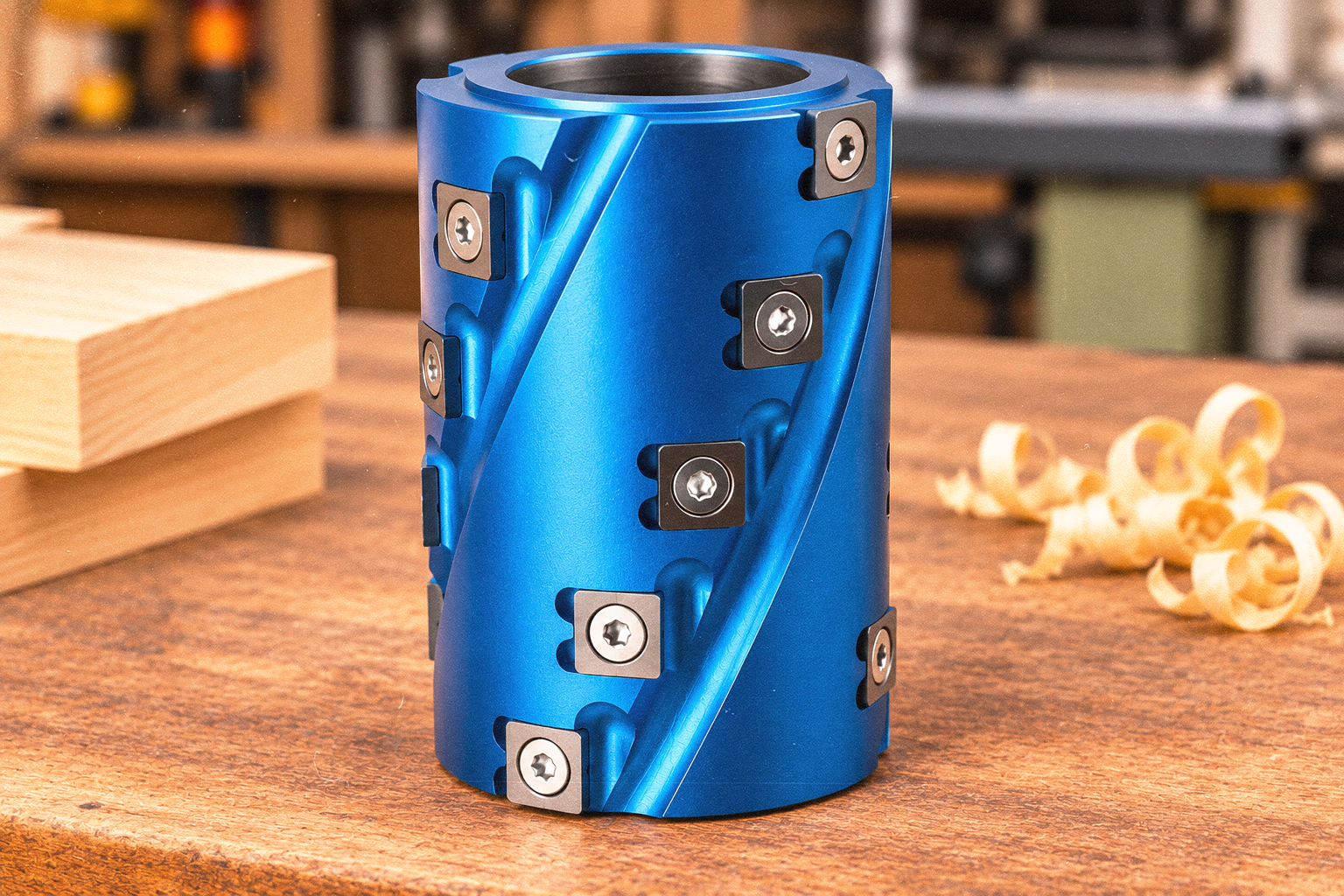
Cutter blocks with replaceable carbide inserts are particularly useful for regular machining operations and repetitive woodworking tasks.
Comparison of the two types of tooling
| Criterion | Interchangeable knives | Carbide inserts |
|---|---|---|
| Profile versatility | High | Depends on the tool design |
| Wear resistance | Depends on the knife material | Generally high |
| Varied decorative woodworking | Highly suitable | Depends on the model |
| Repetitive machining operations | Suitable | Particularly suitable |
| Initial cost | Often affordable | Variable, sometimes higher |
| Maintenance | Sharpening or replacement, depending on the model | Rotation or replacement of inserts |
Neither solution is necessarily superior to the other. Both types of tooling complement each other in a woodworking workshop.
7. What is the difference between MAN and MEC spindle moulder tooling?
When choosing spindle moulder tooling, you may come across the markings MAN and MEC.
These markings indicate, among other things, the type of feed for which the tool has been designed.
MAN cutter blocks
Tools marked MAN are designed for manual feed operations under the conditions specified by their manufacturer.
Their design meets specific requirements intended, among other things, to reduce the risk of workpiece kickback.
They may also be used with certain compatible mechanical feeding devices.
MEC cutter blocks
Tools marked MEC are intended for mechanical feed operations under the conditions specified by their manufacturer.
They must not be used for manual feed operations.
Warning: simply fitting a removable power feeder to a spindle moulder does not automatically mean that MEC tooling can be used. A removable power feeder generally falls within the definition of manual feed under the applicable tooling requirements.
For a conventional workshop spindle moulder, MAN tooling should therefore be selected unless a mechanical feed configuration specifically designed and authorised for MEC tooling is available.
8. Which spindle moulder cutter block should you choose for each woodworking application?
The choice of cutting tool must correspond to the desired profile, the material being machined and the technical specifications of the machine.
| Woodworking application | Recommended cutting tool |
|---|---|
| Decorative mouldings | Universal cutter block with profile knives |
| Rounded profiles and chamfers | Cutter block with suitable knives or a dedicated cutting tool |
| Rebates | Rebating cutter block |
| Fixed-width grooves | Fixed-width grooving cutter |
| Grooves of different widths | Adjustable grooving cutter |
| Cabinet door joints | Profile and counter-profile cutters |
| Solid wood door panels | Raised panel cutter |
| Edge sizing | Sizing cutter block |
| Repetitive machining operations | Dedicated carbide insert tooling suitable for the application |
For those starting out with a spindle moulder, a universal cutter block accompanied by several sets of knives and limiters can provide an excellent starting point.
Additional specialised tooling can then be purchased progressively according to the woodworking operations being carried out.
9. Which outside diameter and rotational speed should you choose?
The outside diameter of a cutter block influences its peripheral cutting speed.
At the same rotational speed, a larger-diameter tool has a higher peripheral speed than a smaller-diameter tool.
It is therefore essential to check compatibility between:
-
The outside diameter of the cutting tool.
-
The speeds available on the spindle moulder.
-
The rotational speed range permitted by the tool manufacturer.
-
The maximum tooling diameter permitted by the machine.
-
The dimensions of the guards and table opening.
-
The usable spindle height.
Cutter blocks generally feature markings indicating their maximum rotational speed or permitted operating speed range.
The effective cutting diameter, including the knives where applicable, must be taken into account rather than simply the diameter of the cutter block body.
Important: never exceed the maximum speed indicated on the cutting tool. The selected speed must also comply with the limits and instructions provided by the spindle moulder manufacturer.
10. What mistakes should you avoid when purchasing a spindle moulder cutter block?
Several mistakes can lead to compatibility issues, poor machining quality or dangerous working conditions.
Failing to check the bore diameter
A cutter block must be compatible with the machine's spindle diameter or with an expressly authorised adaptation system.
Purchasing knives based solely on their height
A height of 40 mm or 50 mm alone does not guarantee compatibility. The fixing system, knife thickness, locating hole spacing and manufacturer's part numbers must also be checked.
Overlooking limiter compatibility
Limiters must correspond to the fitted knives whenever the cutter block is designed to operate with these components.
Choosing an oversized cutter block
A cutter block with an excessive diameter or height may be incompatible with the table opening, spindle or guards of the spindle moulder.
Failing to check the MAN or MEC marking
A cutting tool designed exclusively for mechanical feed must not be used for manual feed operations.
Using poorly maintained tooling
Blunt knives, damaged inserts or resin deposits can reduce machining quality.
If your timber shows signs of tear-out after machining, discover our other practical guides in the Spindle moulders: explanations and operating advice section.
11. Frequently asked questions about spindle moulder cutter blocks
Which cutter block should a beginner choose?
A universal cutter block with interchangeable knives, compatible with the machine and accompanied by several sets of knives and limiters, generally provides a good starting point.
It allows users to explore different profiling operations without immediately having to purchase numerous specialised cutting tools.
What is the most common bore diameter for spindle moulder tooling?
A 30 mm bore is very common on European spindle moulders. However, many other bore diameters are available. It is therefore essential to check the technical specifications of your machine.
Can 50 mm knives be fitted to a 40 mm cutter block?
Only if the manufacturer explicitly states that the cutter block accommodates both sizes. Otherwise, the knives must not be fitted.
Can 40 mm knives be fitted to a 50 mm cutter block?
This depends on the cutter block model. Some standard cutter block bodies allow this, whereas certain 50 mm safety cutter blocks require thicker knives. The locating hole spacing and fixing system must also be checked.
Can carbide inserts be sharpened?
Some inserts are designed to be rotated and subsequently replaced once worn. Other cutting tools can be resharpened by a specialist professional. The manufacturer's recommendations must always be followed.
Can a universal cutter block produce every type of moulding?
No. The possibilities depend on the available knife profiles, the dimensions accepted by the cutter block and the capabilities of the machine. Certain machining operations require specialised tooling.
Can the same cutter block be used for solid wood and wood-based panels?
This depends on the design of the cutting tool and the material of its cutting edges. Carbide insert tooling is often beneficial when machining certain abrasive wood-based panels, but compatibility with the material must always be checked.
When should spindle moulder knives be replaced?
Wood fibre tear-out, an uneven finish or increased cutting resistance may indicate worn knives. A cracked or damaged knife must be removed from service immediately.
12. Probois Machinoutils' advice on choosing the right spindle moulder tooling
Before purchasing a cutter block for your spindle moulder, start by identifying the exact technical specifications of your machine: spindle diameter, available rotational speeds, usable spindle height and maximum permitted tooling diameter.
Next, determine the types of woodworking operations you wish to carry out.
For producing a variety of mouldings, a universal cutter block with interchangeable knives provides a particularly versatile solution. For regular rebating, grooving or sizing operations, specialised tooling can offer greater convenience and more consistent machining results.
At Probois Machinoutils, we offer a comprehensive range of spindle moulder tooling and accessories, including multi-purpose cutter blocks, profile knives and limiters, grooving cutters, rebating cutter blocks, profile and counter-profile cutters, as well as various accessories for woodworking machines.
Remember: a good cutter block is first and foremost a cutting tool that is compatible with your machine, suitable for the material being machined and designed for the intended woodworking operation. Correctly selected and maintained tooling helps improve machining accuracy, surface finish and working conditions.