Clamping Kit for Metalworking Machine Tables: Secure Workholding for Accurate Machining
A clamping kit for metalworking machine tables is an essential collection of accessories designed to hold workpieces securely on the table of a machine tool. Typically consisting of clamping bars, threaded studs, T-slot nuts, clamping nuts and step blocks, it allows users to create different workholding arrangements suited to the shape and dimensions of the components being machined.
Primarily used on milling machines, drilling and milling machines and other machine tools equipped with T-slotted tables, a clamping set provides a versatile solution for securing metal components during machining operations.
At Probois Machinoutils, we offer a selection of machine table clamping kits for mechanical workshops, metalworking professionals, craftspeople and engineering enthusiasts. Available in different sizes, these sets make it possible to equip a machine according to the characteristics of its table and the operations to be performed.
What Is a Machine Tool Clamping Kit?
A machine clamping kit, also known as a milling machine clamping set, contains several components that allow a workpiece to be secured directly to the machine table.
Unlike a machine vice, which generally holds a component between two jaws, a clamping system uses clamping bars and fixing elements to apply pressure to specific areas of the workpiece.
This method is particularly useful when a component is too large, too long or too irregularly shaped to be held correctly in a conventional vice.
A clamping kit may also be used to secure suitable fixtures, supports or other accessories to the machine table.
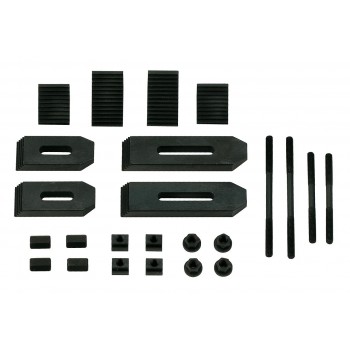
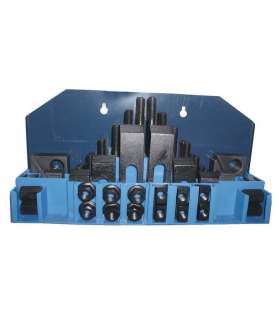
A typical T-slot clamping kit may contain the following components:
- Clamping bars: these apply downward pressure to hold the workpiece against the machine table or suitable supports.
- Threaded studs: these connect the clamping components and allow different clamping heights to be accommodated.
- T-slot nuts: these fit into the T-slots of the machine table to provide secure anchoring points.
- Clamping nuts: these are used to apply and maintain the required clamping force.
- Step blocks: these support the rear of the clamping bars at different heights.
- Additional fixing components: depending on the kit, washers or other accessories may also be included.
The exact contents vary between products. It is therefore important to check the technical specifications and component list before purchasing.
Why Use a Clamping Set on a Milling Machine?
During machining, the cutting forces generated by the tool can cause an inadequately secured workpiece to move or vibrate.
A milling machine clamping kit allows several holding points to be created, helping to stabilise the component on the machine table.
This workholding method offers several advantages:
- Reliable workpiece holding: clamping bars help secure the component during operations compatible with the chosen arrangement.
- Versatile configurations: the different components allow several clamping arrangements to be assembled.
- Suitable for larger workpieces: direct clamping can be useful when a component is difficult to fit into a conventional machine vice.
- Adjustable clamping height: step blocks allow the supporting height of the clamping bars to be adapted.
- Multiple clamping points: several clamps can be positioned to stabilise workpieces of different shapes.
- Use of machine table T-slots: compatible T-slot nuts make use of the fixing arrangements provided by the machine manufacturer.
However, the clamping arrangement must always be correctly designed and positioned. Excessive pressure may deform certain components, while insufficient clamping force can allow the workpiece to move during machining.
The stability of the entire assembly must be checked before starting the machine.
Machine Clamping Bars: Holding the Workpiece Securely
A machine clamping bar is one of the main components of a workholding kit. It is designed to apply pressure to a specific area of the component being secured.
Depending on its shape and the available mounting arrangement, a clamping bar can be used to hold a workpiece directly against the machine table or against suitable supports.
It is generally used together with a threaded stud, a clamping nut and a supporting element positioned at the opposite end.
For reliable clamping, the bar must be properly supported at its contact points, and the pressure must be applied to a sufficiently strong area of the workpiece.
An incorrectly positioned clamping bar may slip, bend or apply force in an unsuitable direction.
The shape, rigidity and contact surfaces of the component, together with the expected machining forces, must therefore be considered when preparing the clamping arrangement.
Where necessary, suitable packing pieces or supports can help provide a stable mounting surface.
T-Slot Nuts and Threaded Studs: Essential Machine Table Fixings
T-slot nuts for milling machines provide anchoring points within the slots of the machine table.
They are designed to fit the profile of the T-slots and accept the threaded fixing components required for the clamping arrangement.
Threaded clamping studs connect these anchoring points to the clamping bars and associated nuts.
Compatibility between the T-slot nuts and the machine table is essential. Selecting a nut with the correct thread size is not enough: its external dimensions must also match the profile of the T-slot.
A nut that is too large will not fit correctly into the slot. A nut that is too small or incorrectly shaped may not provide adequate support.
The length of the threaded studs must also be selected according to the height of the workpiece, the position of the clamping bars and the overall mounting arrangement.
All threaded components must be mutually compatible and used in accordance with the manufacturer's instructions.
Correctly matched T-slot nuts, studs and clamping nuts are essential for creating a reliable workholding assembly.
Step Blocks for Machine Clamping: Adjusting the Support Height
Step blocks for machine clamping are designed to support the rear of the clamping bars at different heights.
They are particularly useful when the workpiece extends above the machine table or rests on additional positioning supports.
Their stepped construction provides several support levels, making it possible to adjust the height of the clamping bar.
By combining a suitable clamping bar with the appropriate step block, users can create a holding arrangement adapted to the thickness of the component.
It is important to ensure that the supporting surfaces are stable and that the clamping bar does not rest on an area likely to slip during machining.
The step blocks must also be strong enough to withstand the forces applied.
Correctly distributed support points help improve the stability of the assembly and reduce the risk of workpiece deformation.
Before machining begins, the position of each block should be checked to ensure that the clamp remains correctly supported.
How to Choose a T-Slot Clamping Kit Compatible with Your Machine
Choosing a clamping kit for a milling machine or drilling and milling machine depends primarily on the dimensions of the T-slots in the machine table.
These slots accommodate the fixing nuts and must be compatible with the components supplied in the kit.
Clamping sets are available in different sizes, particularly according to the T-slot dimensions and the diameter of the threaded components.
Before choosing a kit, check the following characteristics:
- T-slot width: the slot opening must be compatible with the dimensions of the supplied T-slot nuts.
- T-slot profile: the internal dimensions must allow the nuts to seat correctly.
- Thread diameter: the threaded studs and nuts must be compatible with one another.
- Stud length: the available lengths must allow workpieces of different heights to be clamped.
- Clamping bar dimensions: the bars must suit the components and available support points.
- Step block height: the available adjustment range must be suitable for the intended mounting arrangements.
- Kit contents: the number and type of components should meet the requirements of the workshop.
It is advisable to consult the machine manual or measure the T-slots accurately before ordering.
For example, a designation such as M10, M12 or M14 generally refers to the metric thread diameter and does not necessarily indicate the width of the T-slot.
These two dimensions must be checked separately to avoid compatibility problems.
When replacing an existing clamping kit, comparing the original T-slot nut dimensions with those of the new set can help identify the correct product.
Which Machines Can Be Equipped with a Clamping Kit?
A clamping kit for metalworking machine tables can be used with different types of equipment featuring compatible mounting points.
It is particularly common on milling machines and drilling and milling machines equipped with T-slotted tables.
On a milling machine, direct workpiece clamping can be used to secure plates, metal blocks and components whose dimensions make the use of a vice impractical.
On a drilling and milling machine, a suitable clamping set can help immobilise components during drilling or machining operations permitted by the machine manufacturer.
Certain clamping arrangements may also be used on pillar drills equipped with compatible tables, provided that the fixing dimensions and permitted loads are suitable.
However, a single clamping kit should not automatically be considered compatible with every machine.
The table construction, the strength of the fixing components and the forces generated during machining must always be taken into account.
Correct machine compatibility is essential for both effective workholding and safe operation.
What Is the Difference Between a Clamping Kit and a Machine Vice?
A machine vice and a machine table clamping kit are both designed to hold workpieces during machining, but they operate in different ways.
A vice generally uses two jaws to grip a component. It provides a convenient solution for workpieces that can be correctly positioned between the clamping surfaces.
A clamping kit, on the other hand, allows a component to be secured directly to the machine table using several clamping bars and anchoring points.
This method can be particularly useful for large flat components, irregularly shaped workpieces or parts requiring several holding points.
A vice is often quicker to use for repetitive operations involving smaller components, whereas direct clamping offers greater flexibility for special workholding arrangements.
These two systems are therefore complementary accessories in a mechanical workshop.
The most suitable solution depends on the geometry of the workpiece, the machining operations planned and the mounting possibilities offered by the machine.
How to Clamp a Workpiece Correctly on a Milling Machine Table
Correct workpiece clamping on a milling machine table requires careful preparation of the supporting surfaces and suitable positioning of the clamping points.
Before installation, clean the machine table, the T-slots and the contact surfaces of the workpiece.
Metal chips and other debris can prevent even contact and cause inaccurate positioning.
The T-slot nuts should then be inserted into the appropriate slots and connected to the threaded studs and clamping bars.
Step blocks must provide proper support for the clamping bars so that the required holding force can be applied.
Before starting the machine, check that:
- The workpiece rests on stable supporting surfaces.
- The T-slot nuts are correctly engaged in the table slots.
- The threaded studs and nuts are compatible and in good condition.
- The clamping bars apply pressure to suitable areas of the component.
- The step blocks are correctly positioned.
- The workpiece cannot move unexpectedly.
- The cutting tool cannot come into contact with any clamping components.
When several clamping bars are used, tightening should be carried out progressively and evenly.
Sufficient clearance must also be provided for the movement of the machine table and the cutting tool.
All adjustments to the clamping arrangement must be performed with the machine completely stopped.
Never attempt to reposition or hold a loose workpiece by hand while the machine is running.
How to Maintain and Store a Machine Clamping Kit
A metalworking machine clamping set contains several metal components that require regular maintenance to preserve their condition and functionality.
After use, clean the clamping bars, threaded studs, T-slot nuts and step blocks to remove metal chips and machining residues.
The threads should be inspected for signs of damage, deformation or significant corrosion.
Damaged components should not be reused without appropriate inspection, as they may compromise the reliability of the clamping arrangement.
Depending on the manufacturer's recommendations, a light protective coating may be applied to suitable metal surfaces to reduce the risk of corrosion.
It is also advisable to store the individual components in an organised manner, particularly in their original holder or storage case when one is supplied.
Organised storage makes it easier to identify the different sizes and quickly find the components required for each workholding arrangement.
Regular inspection and proper storage help extend the service life of the clamping kit.
Why Buy Your Machine Table Clamping Kit from Probois Machinoutils?
Specialising in woodworking and metalworking machines, Probois Machinoutils offers a selection of clamping kits for milling machines, drilling and milling machines and other machine tools.
Our workholding sets allow users to complete their workshop equipment and create different clamping arrangements on compatible machine tables.
Depending on the available references, we supply accessories from recognised machine tool and workshop equipment brands, including Holzmann and Bernardo.
To complete your workshop setup, explore our drilling machine vices, swivel base machine vices, milling accessories and metal cutting tools.
Whether you want to equip a new milling machine, replace worn fixing components or obtain a versatile set for different machining operations, choosing a clamping kit compatible with your machine's T-slots helps create more practical, stable and secure workholding arrangements.