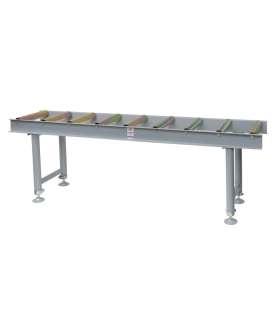
Roller Conveyors for Workshops: Easier Handling of Long and Heavy Workpieces
A roller conveyor is a workshop accessory designed to support, guide and facilitate the movement of long or heavy workpieces during cutting, machining and material handling operations.
It is particularly useful in woodworking, carpentry, joinery, metalworking and fabrication workshops equipped with stationary machinery.
Unlike an individual roller stand, a roller conveyor for workshop machinery features several rollers distributed along a supporting frame. This construction provides support over a greater length and helps materials move along the rollers.
At Probois Machinoutils, we offer a selection of Holzmann and Bernardo roller conveyors designed for different workshop applications.
Our range includes fixed roller conveyors, extendable models, folding conveyors and conveyor tables equipped with adjustable length stops.
Different lengths and load capacities allow users to select equipment suited to their woodworking or metalworking operations.
Whether you need additional support for a metal-cutting bandsaw, a woodworking machine or a material preparation station, a suitable roller conveyor can help organise your working environment.
Why Use a Roller Conveyor in Your Workshop?
When a workpiece extends significantly beyond the table of a machine, its length and weight can make handling difficult.
A workshop roller conveyor provides an additional supporting surface at the infeed or outfeed side of certain machines.
The rollers rotate as the material moves, helping it travel along the conveyor.
This configuration can make handling long boards, timber beams, metal profiles, tubes and other compatible materials more convenient.
Unlike a single roller stand, a conveyor distributes the support across several rollers.
This can be particularly useful when processing long materials that require support over a greater distance.
A roller conveyor may be installed near certain metal-cutting bandsaws, table saws, thickness planers or other cutting and machining equipment.
In workshops where long workpieces are cut regularly, this type of equipment contributes to a more organised workstation.
However, a roller conveyor does not replace the machine manufacturer's safety devices, guides or workpiece-clamping systems.
Its installation and use must always comply with the operating requirements of the machinery concerned.
Fixed Roller Conveyor: A Robust Solution for Long Workpieces
A fixed roller conveyor is particularly suitable for workstations requiring a stable supporting surface that remains available for regular use.
It generally consists of a metal frame equipped with several rollers and a supporting structure designed for installation near a machine.
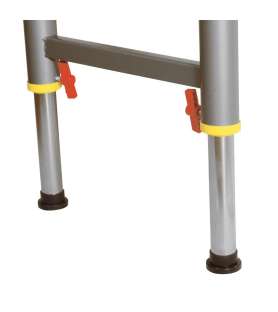
Depending on the model, the working height may be adjustable to match the machine table.
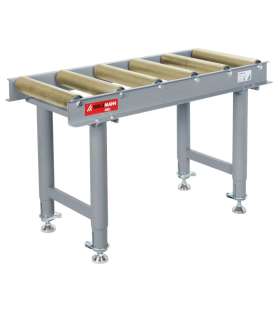
The Holzmann RB6 is a lightweight roller conveyor with a length of 1,000 mm.
It features six rollers with a stated width of 365 mm, an adjustable working height from 600 to 1,000 mm and a stated maximum load capacity of 400 kg.
It provides a solution for supporting long workpieces within the manufacturer's specified limits.
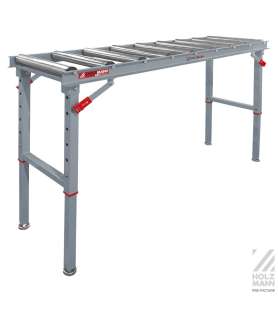
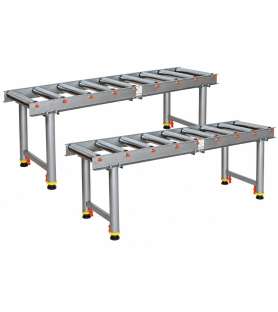
The Holzmann RB9L, with a length of 1,650 mm, features nine rollers and a stated maximum load capacity of 200 kg.
For workshops requiring a longer supporting surface, the Holzmann RB9 offers a length of 2,000 mm.
This model is also available in an offer requiring a minimum purchase of two units.
Fixed conveyors can be especially useful when a machine remains installed in the same position and cutting operations regularly require additional material support.
Bernardo Roller Conveyors: Models for Heavy Loads
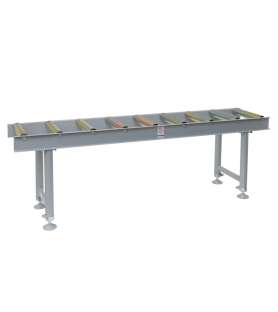
The Bernardo roller conveyor range includes several models designed to support and move long and heavy workpieces.
The range includes the RB4, RB7, RB10 and RB13, available in different lengths and load capacities.
The Bernardo RB4 offers a length of 1,000 mm and a stated maximum load capacity of 500 kg.
The Bernardo RB7 has a length of 2,000 mm and a stated maximum load capacity of 700 kg.
For applications requiring a longer supporting surface, the Bernardo RB10 provides a length of 3,000 mm and a stated maximum load capacity of 900 kg.
The Bernardo RB13 reaches a length of 4,000 mm, with a stated maximum load capacity of 1,200 kg.
These different configurations allow users to choose a heavy-duty roller conveyor according to the length and weight of the materials being handled.
The stated load capacities must always be considered under the conditions specified by the manufacturer, particularly regarding load distribution.
A long roller conveyor can be especially useful in workshops regularly handling metal profiles, timber beams or other lengthy materials.
However, it is essential to check that the dimensions and specifications of the selected model match the intended application.
Extendable Roller Conveyor: Adjust the Supporting Length
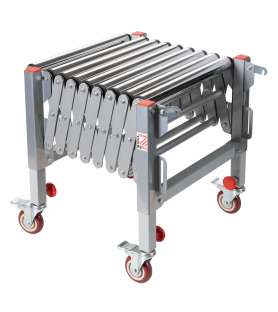
An extendable roller conveyor allows the length of the supporting structure to be adjusted according to material handling requirements.
This design is particularly interesting for workshops where workpiece dimensions vary or where the available space needs to be used flexibly.
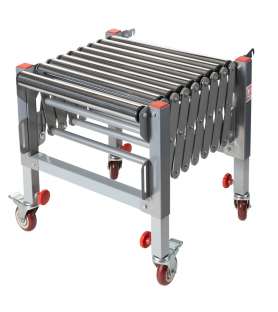
The Holzmann RB9A is an extendable roller conveyor with a stated maximum extended length of 1,400 mm.
Its stated maximum load capacity is 130 kg.
This type of conveyor can be used to support long workpieces during certain preparation and machining operations.
The main advantage of an extendable conveyor is the ability to adjust its configuration to the required supporting length, within the manufacturer's specified limits.
Before use, the structure must be correctly extended and stabilised.
Adjustment and locking mechanisms should be checked according to the assembly instructions.
An extendable roller conveyor for workshop use can therefore be a practical solution when supporting requirements change regularly.
Folding Roller Conveyor: Easy Storage in the Workshop
In a workshop with limited floor space, leaving a conveyor permanently installed may not be practical.
A folding roller conveyor can provide an interesting alternative.
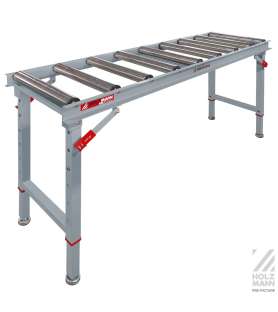
The Holzmann RB9FOLD is a folding conveyor equipped with nine rollers.
It has a stated maximum load capacity of 200 kg and offers six height adjustment positions, from 650 to 1,100 mm.
Its legs can be folded without tools to reduce the amount of space required for storage.
This feature is particularly useful for operators who only need an additional supporting surface during certain operations.
The conveyor can be set up when long workpieces need to be processed and then stored to free up workshop space.
Before each use, it is essential to check that the legs are correctly extended and that all locking mechanisms are engaged according to the manufacturer's instructions.
A folding roller conveyor for woodworking or metalworking machinery combines material support with practical workshop organisation.
Roller Conveyor with Adjustable Length Stop: Position Workpieces for Cutting
For certain cutting operations, an adjustable stop can be useful for positioning a workpiece at a predetermined distance.
A roller conveyor with length stop combines a supporting structure with a positioning device.
This configuration can help prepare repetitive cuts when the system is compatible with the machine and the operation being performed.
The Bernardo range includes several conveyor models equipped with an adjustable stop.
The Bernardo RB1000A has a length of 1,000 mm and a stated maximum load capacity of 500 kg.
The Bernardo RB2000A offers a length of 2,000 mm and a stated maximum load capacity of 700 kg.
The Bernardo RB3000A provides a length of 3,000 mm and a stated maximum load capacity of 900 kg.
These models allow users to select a supporting length suited to the workpieces being handled.
An adjustable stop can be particularly useful for certain operations requiring consistent material positioning.
However, it is important to check that the stop is suitable for the machine and that it does not create a risk of trapping or kickback.
A roller conveyor with length stop for a metal bandsaw may be useful in certain cutting configurations, subject to compatibility with the equipment.
PVC Rollers for Bernardo Conveyors: An Option for Certain Delicate Surfaces
The type of roller can also influence the choice of conveyor equipment.
Metal rollers are commonly used to support and move various materials in workshops.
However, some workpieces may have surfaces that are sensitive to marking or direct contact with metal.
For certain applications, PVC-coated conveyor rollers can be used on compatible conveyor systems.
Probois Machinoutils offers a set of three PVC rollers for Bernardo RB4, RB7, RB10 and RB13 roller conveyors.
This accessory allows certain Bernardo conveyor models to be adapted to applications requiring a different contact surface.
Before ordering replacement rollers or accessories, it is important to check the exact conveyor reference.
The nature of the materials being handled and the manufacturer's recommendations must also be considered.
PVC rollers do not guarantee that every surface will remain completely free from marks, but they can offer an interesting option for certain applications.
Which Roller Conveyor Should You Choose for a Metal-Cutting Bandsaw?
A metal-cutting bandsaw is frequently used to cut tubes, bars and metal profiles of different lengths.
When materials extend beyond the cutting area, a roller conveyor can provide additional support.
It helps support part of the material before or after cutting, depending on the workstation layout.
For relatively short workpieces, a compact roller conveyor may be sufficient.
For longer profiles, a conveyor measuring 2, 3 or 4 metres may be more appropriate.
The choice also depends on the weight of the materials and the maximum load capacity of the conveyor.
Models equipped with an adjustable stop may be useful for certain repetitive positioning operations.
However, the presence of a conveyor never removes the need to follow the bandsaw manufacturer's workpiece-holding, clamping and safety instructions.
The conveyor height must be adjusted to match the machine so that it does not place inappropriate forces on the material.
Roller Conveyors for Woodworking Machinery: Supporting Boards and Beams
Roller conveyors for woodworking machines can be used to support certain long materials during sawing and preparation operations.
In joinery, carpentry and timber workshops, long boards, beams and timber sections may require several supporting points.
A conveyor distributes the support across multiple rollers, which can make longitudinal movement easier.
It may be installed near a machine when the operating conditions allow.
For a table saw or thickness planer, the conveyor height and position must be adjusted carefully.
An incorrectly positioned support can alter the way the workpiece rests on the machine table.
It is therefore essential to follow the manufacturer's recommendations and never use a conveyor in a way that interferes with normal material guidance.
For workpieces with delicate surfaces, the type of roller should also be considered.
How to Choose the Right Roller Conveyor Length and Load Capacity
Before purchasing a roller conveyor for workshop use, several criteria should be considered.
The first is the conveyor length.
A 1,000 mm structure may be suitable for certain occasional applications, while a 2,000, 3,000 or 4,000 mm model provides a longer supporting surface.
The second criterion is the maximum load capacity.
It must be suitable for the weight of the materials and the load distribution conditions specified by the manufacturer.
The working height is another essential consideration.
The conveyor must be positioned correctly in relation to the machine or material handling workstation.
The type of structure should then be selected according to the intended application: fixed, extendable, folding or equipped with an adjustable stop.
Finally, the nature of the materials, their dimensions and the type of rollers must be taken into account.
A properly selected conveyor helps create a more functional workstation suited to the workshop's requirements.
What Is the Difference Between a Roller Conveyor and a Roller Stand?
A roller conveyor and a roller stand perform complementary functions, but their construction is different.
A roller stand generally provides an individual supporting point equipped with a horizontal roller, multidirectional ball transfer units or a multifunction supporting system.
It allows a workpiece to be supported at a specific location and can usually be moved easily between workstations.
A roller conveyor features several rollers distributed along a longer frame.
It therefore provides support over a greater distance and can be suitable for applications requiring a more continuous supporting surface.
For occasional or localised support, a height-adjustable roller stand may be sufficient.
For regularly handling long or heavy materials, a roller conveyor may be more appropriate.
The correct choice depends on the machines, the length of the workpieces, the weight to be supported and the available workshop space.
Installation, Maintenance and Safe Working Practices
A workshop roller conveyor must be installed on a sufficiently stable, level and load-bearing floor.
Before use, the frame assembly, fastening components and supporting legs should be checked.
When the model features height adjustment, it must be set to suit the workstation.
The rollers should rotate freely, without excessive accumulation of wood shavings, dust or metal residues.
Regular cleaning helps maintain their proper operation.
It is also advisable to inspect fastening components and adjustment mechanisms periodically.
On folding or extendable models, the locking systems should be checked before each use.
Loads must be placed and moved according to the manufacturer's instructions, without exceeding the specified limits.
Finally, a roller conveyor must not be used as a lifting device or as safety equipment for applications for which it was not designed.
Holzmann and Bernardo Roller Conveyors at Probois Machinoutils
At Probois Machinoutils, we offer a range of roller conveyors for woodworking and metalworking workshops, designed to support and facilitate the handling of long workpieces.
Our selection includes the Holzmann RB6, RB9L, RB9, RB9A and RB9FOLD roller conveyors, together with the Bernardo RB4, RB7, RB10 and RB13 models.
We also offer the Bernardo RB1000A, RB2000A and RB3000A conveyors with adjustable length stops, as well as PVC rollers compatible with selected models.
Whether you are looking for a roller conveyor for a metal-cutting bandsaw, an extendable roller conveyor, a folding roller conveyor or a heavy-duty roller conveyor, you can compare the available models according to their length, load capacity and features.
Discover our selection of Holzmann and Bernardo roller conveyors to create a more practical workshop, facilitate material handling and provide suitable support for your machinery.