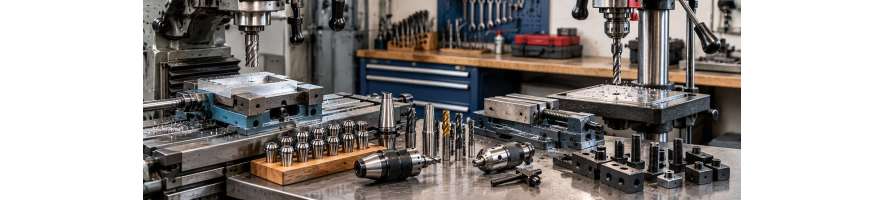
Drill Press Vice: Secure and Accurate Workpiece Clamping for Drilling Machines
A drill press vice is an essential accessory for securely holding workpieces during drilling, counterboring and countersinking operations. Installed on the table of a drill press, it helps stabilise the workpiece, improve machining accuracy and reduce the risk of unwanted movement while the machine is operating.
Whether you work with steel, aluminium, brass or other materials compatible with your equipment, a drilling machine vice makes positioning and clamping workpieces easier. It is particularly useful in mechanical workshops, maintenance departments, metal fabrication workshops and general engineering applications.
At Probois Machinoutils, we offer a selection of drill press vices for metalworking suitable for hobbyists, craftspeople and professional users. Our range includes standard drilling vices, models with V-groove jaws and vices offering different clamping capacities, including products from specialist brands such as Holzmann and Bernardo.
Why Use a Vice on a Drill Press?
When drilling a metal workpiece, the drill bit generates cutting forces that may cause the material to move or rotate if it is not properly secured. Holding a workpiece by hand during drilling is dangerous and does not provide sufficiently reliable positioning.
Using a drill press clamping vice allows the workpiece to be held between two jaws, helping to minimise unwanted movement during machining.
A suitable drilling vice offers several important advantages:
- Improved workpiece holding: the jaws apply clamping pressure suited to the shape and dimensions of the material.
- Greater drilling accuracy: the workpiece remains correctly positioned in relation to the drill bit.
- Better repeatability: successive drilling operations can be performed under more consistent clamping conditions.
- Improved working comfort: positioning and securing components becomes easier, particularly when producing small batches.
- Enhanced safety: a vice securely fixed to the machine table reduces the risk of the workpiece rotating or shifting.
However, it is important to remember that the vice itself must be firmly secured to the drill press table. Simply tightening a workpiece between the jaws does not provide sufficient protection if the entire vice can move during drilling.
Standard Drill Press Vice: A Versatile Workshop Accessory
A standard drill press vice is appreciated for its straightforward design and versatility. It generally consists of a metal body, a fixed jaw, a moving jaw and a screw mechanism used to apply clamping pressure.
This type of vice is suitable for many everyday operations performed on a metalworking drill press. It can be used to hold flat metal bars, small plates, profiles and mechanical components with compatible dimensions.
Different models can be distinguished by their jaw width, maximum jaw opening, clamping depth and overall dimensions.
A compact vice may be sufficient for small mechanical jobs and occasional workshop tasks, while a wider model provides additional clamping surface for larger components.
The dimensions of the drilling machine table must also be considered. An excessively large vice may reduce the available working area or make it difficult to position the workpiece beneath the spindle.
Choosing the right vice therefore involves finding a balance between clamping capacity, overall size and the practical requirements of the drilling operation.
Drilling Vice with V-Groove Jaws: Holding Round Workpieces
Some drill press vices are equipped with prismatic jaws or specially designed V-grooves that help position cylindrical workpieces.
This feature is particularly useful when drilling tubes, shafts, round bars and other components with curved surfaces.
When a cylindrical workpiece is held between conventional flat jaws, it may be difficult to prevent movement or rotation. V-groove jaws provide additional contact points that help stabilise the material.
A drilling vice with V-groove jaws can therefore be a practical choice for workshops that regularly drill round metal components.
However, it is essential to ensure that the jaw geometry is suitable for the diameter of the workpiece and that the clamping arrangement can withstand the forces generated during drilling.
Depending on the shape of the component, additional supports, suitable jaw inserts or supplementary clamping devices may be necessary.
V-groove jaws are particularly useful for repetitive operations where maintaining a consistent position on round components is important.
Which Jaw Width Should You Choose for a Drill Press Vice?
The jaw width of a drilling vice is one of the main characteristics to consider when selecting a model. It influences the contact surface available for holding the workpiece.
Smaller vices are generally suitable for compact components and detailed workshop operations. Wider models are better suited to workpieces requiring a larger clamping surface.
Our selection includes different vice sizes to meet a variety of workshop requirements, with models offering jaw widths of approximately 100, 120 or 150 mm, depending on the product reference.
However, jaw width should not be confused with maximum jaw opening.
A vice with 100 mm wide jaws does not necessarily have the capacity to hold a workpiece measuring 100 mm between those jaws.
The maximum jaw opening refers to the available distance between the jaws when they are fully opened. This specification should always be checked in the technical description of the chosen model.
Jaw depth, jaw height and the actual clamping capacity may also influence the suitability of a vice for a particular application.
For accurate product selection, compare all relevant dimensions rather than relying on jaw width alone.
How to Choose a Drill Press Vice Compatible with Your Machine
When choosing a vice for a pillar drill or drill press, several technical characteristics should be considered before purchasing.
- Drill press table dimensions: make sure the vice can be installed without excessive overhang or interference with the required movements.
- Mounting points: check that the mounting holes or slots are compatible with the machine table.
- Jaw width: select a size appropriate for the components you usually machine.
- Maximum jaw opening: ensure that the workpieces can be positioned correctly between the jaws.
- Vice height: consider the available clearance between the table and the drill chuck.
- Jaw design: choose V-groove jaws when cylindrical components are frequently drilled.
- Weight and overall dimensions: select a model compatible with the table load capacity and workshop handling requirements.
Frequency of use is another important factor. For occasional drilling operations, a standard vice may provide everything required.
For regular workshop use, construction quality, smooth screw operation and ease of workpiece positioning become particularly valuable.
Always consult the specifications of both the drilling machine and the vice to ensure that the selected accessory is suitable for the intended application.
How to Secure a Vice to a Drill Press Table
Correctly mounting a drilling vice on a drill press table is essential for safe and accurate operation.
Many drilling machine tables feature slots or mounting openings that allow the use of suitable bolts, nuts and clamping accessories. These components are designed to hold the vice securely in position before the machine is started.
Before installation, clean the table surface and the base of the vice to remove metal chips, dust and other debris that could prevent proper contact.
The vice should then be positioned so that the drill bit can pass through the workpiece without contacting the jaws or the body of the vice.
It is also important to check that the workpiece is firmly clamped and that the vice mounting system has no unwanted movement.
When drilling completely through a component, sufficient clearance must be provided beneath the workpiece to avoid damaging the drill bit or the vice.
The machine must always be switched off before adjusting the position of the vice or repositioning the workpiece.
Never attempt to restrain a loose vice by hand while the drill press is operating.
Drilling Vices for Steel, Aluminium and Other Metals
A metalworking drilling vice can be used to hold many different materials, provided that the workpiece dimensions, cutting forces and machine capabilities are compatible.
When drilling steel, secure clamping is especially important, particularly as the drill diameter increases. An inadequately supported workpiece may cause vibration, poor surface finish or unexpected movement during machining.
For aluminium and softer metals, protective jaw covers may be useful to reduce marking on finished surfaces.
Small components require particular attention. Their clamping arrangement must be sufficiently secure to prevent them from being caught and rotated by the drill bit.
In all cases, spindle speed, feed rate, drill diameter and any cutting lubricant should be selected according to the material being machined and the machine manufacturer's recommendations.
Using a suitable vice improves workpiece stability, but it does not replace correct machining practices or appropriate personal protective equipment.
What Is the Difference Between a Drilling Vice and a Milling Vice?
A drilling vice and a milling machine vice may look similar, but they are not necessarily designed to withstand the same mechanical loads.
A drilling vice is primarily intended to hold workpieces during operations performed on a drill press. It must resist the forces generated as the drill bit enters the material.
A milling vice is generally designed for operations involving lateral cutting forces and specific workpiece holding requirements. Depending on the model, it may feature a more rigid construction, improved guiding surfaces or particular jaw arrangements.
A standard drill press vice should therefore not automatically be considered suitable for milling operations.
When equipping a milling machine or a drilling and milling machine, it is preferable to choose a vice specifically approved for the intended operations and compatible with the machine's capabilities.
Correctly distinguishing between these accessories helps prevent inappropriate equipment selection and improves workshop safety.
How to Maintain a Drill Press Vice
A drill press vice requires regular maintenance to preserve smooth operation and effective clamping.
After each use, remove metal chips from the jaws, sliding surfaces and screw mechanism.
Sharp metal chips should never be removed with bare hands. Use a suitable brush or cleaning accessory while the machine is switched off.
The screw and moving components may require light lubrication in accordance with the manufacturer's instructions. This helps reduce wear and allows the moving jaw to operate smoothly.
Regularly inspect the condition of the jaws, check for excessive play and ensure that the clamping mechanism functions correctly.
A vice showing cracks, significant deformation or a defective clamping mechanism should not be used until it has been properly inspected and repaired or replaced.
Good maintenance practices contribute to consistent performance and help extend the service life of workshop equipment.
Why Buy Your Drill Press Vice from Probois Machinoutils?
Specialising in woodworking and metalworking machines, Probois Machinoutils offers a selection of drill press vices designed to meet different workshop requirements.
Our range includes models in various sizes, along with vices offering specific features such as V-groove jaws for improved positioning of certain cylindrical workpieces.
We supply accessories from brands including Holzmann and Bernardo, which offer a wide range of machine tools and workshop equipment.
To complete your workshop setup, explore our drill press accessories, drill chucks, metal drill bits and clamping solutions for machine tables.
Whether you are equipping a new drilling machine, replacing a worn vice or improving the way you secure your workpieces, choosing a drill press vice suited to your machine helps achieve more consistent, accurate drilling operations under safer working conditions.