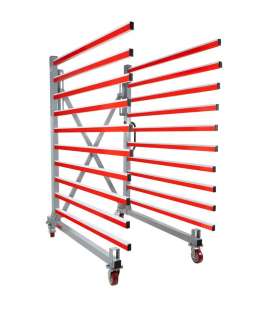
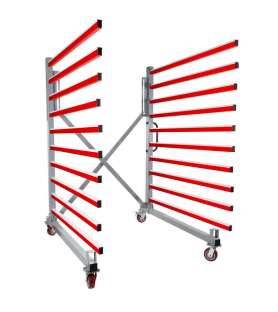
Panel Drying Rack Trolleys: A Practical Solution for Painting and Woodworking Workshops
A panel drying rack trolley is particularly useful in woodworking shops, cabinetmaking workshops, furniture manufacturing facilities and wood finishing areas. It allows freshly painted, varnished or lacquered components to be placed on several levels while making efficient use of the available workshop space.
When manufacturing furniture, doors, kitchen fronts or interior fittings, finishing operations require suitable organisation. After applying paint, varnish or lacquer, components generally need to be placed in an appropriate environment without coming into contact with surfaces that could mark or damage their finish.
A mobile drying rack allows several components to be arranged on a structure equipped with individual supports, keeping space between the workpieces. This arrangement makes temporary storage easier and helps reduce unnecessary handling during the different drying stages.
At Probois Machinoutils, we offer a selection of Holzmann drying rack trolleys designed for woodworking professionals, painting workshops and craftspeople looking to organise their finishing areas efficiently.
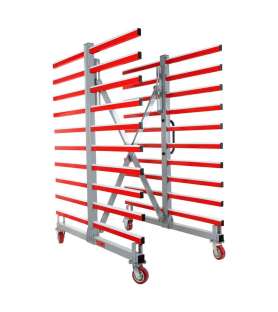
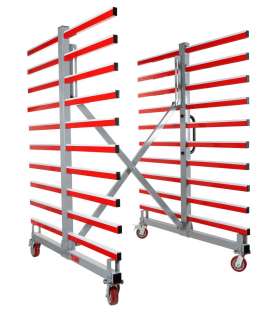
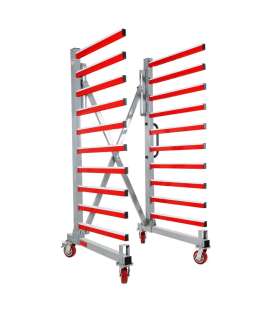
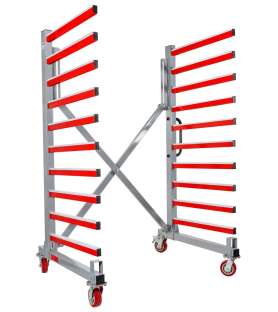
Discover the Holzmann TAW70DUO, TAW76 and TAW140, designed to facilitate the storage, transport and drying of wooden panels and components.
Why Use a Drying Rack in a Workshop?
In a finishing workshop, drying workpieces can quickly occupy a considerable amount of space.
Cabinet doors, furniture fronts, panels and other painted or varnished components must be arranged to avoid contact that could damage their surfaces.
Without suitable equipment, workpieces may occupy workbenches, work tables and circulation areas.
Using a wood drying rack allows several components to be distributed across different levels rather than placed on numerous separate surfaces.
This organisation offers several advantages: it makes workpiece storage easier, frees up workshop space and allows the entire rack to be moved when operating conditions permit.
The spacing between the supports also encourages air circulation around the components. However, it does not replace the temperature, humidity and ventilation conditions recommended by finishing product manufacturers.
Drying times depend on several factors, including the coating applied, its thickness, the material being finished and the surrounding conditions.
Mobile Drying Rack: Make Better Use of Workshop Space
A mobile drying rack for workshops is particularly useful when several components need to dry simultaneously.
Thanks to its multiple support levels, it makes use of the available vertical space instead of requiring additional floor areas for storage.
This feature is especially valuable in smaller woodworking workshops, where preparation, machining, assembly and finishing operations may share the same workspace.
The castors allow the rack to be moved to a suitable drying area, provided the manufacturer's recommendations and the precautions required for freshly coated components are respected.
A mobile drying rack can also help organise the different stages of production.
Workpieces can be grouped by customer order, finishing product or production stage, making them easier to identify.
For professionals who regularly manufacture batches of components, this organisation can contribute to a smoother workflow.
Holzmann TAW70DUO Drying Rack: A Double-Sided Solution for Workshops
The Holzmann TAW70DUO double mobile drying rack is designed for transporting, storing and drying wooden panels or components after painting.
Its construction allows different workpieces to be arranged on a mobile structure suited to organising a finishing workshop.
The rack width can be adjusted from 300 to 1250 mm, allowing it to accommodate materials of different dimensions.
This adjustable configuration is an advantage for professionals working with components of varying sizes.
The TAW70DUO can be particularly useful in furniture manufacturing workshops, where cabinet fronts, panels and interior fittings may vary in size from one project to another.
It can also serve as a temporary storage support for components compatible with its technical specifications.
Before each use, it is important to check the permitted dimensions, load capacities and workpiece positioning instructions.
Holzmann TAW76 Drying Rack: Storage and Drying for Wooden Panels
The Holzmann TAW76 mobile drying rack is intended for workshops looking for a practical solution for arranging panels and components after painting or varnishing.
It can be used as a drying support, but also as storage or transport equipment for suitable materials.
Its width is adjustable from 300 to 1250 mm.
This adjustment range allows the rack configuration to be adapted to the dimensions of the components being stored.
In a woodworking workshop, the TAW76 can be used to organise workpieces before the next handling operation, particularly after applying a finishing product.
It is especially useful when several panels need to be kept separate during drying.
As with any equipment of this type, the model should be selected according to the weight and dimensions of the components and the load limits specified by the manufacturer.
Holzmann TAW140 Drying Rack: Organise Your Finishing Operations
The Holzmann TAW140 mobile drying rack is designed for transporting, storing and drying wooden panels or components after painting.
It provides a solution for professionals who want to organise their workpieces on a mobile support.
The width is adjustable from 300 to 1250 mm, allowing it to accommodate different panel sizes and joinery components.
This type of drying rack can be used in furniture manufacturing, interior joinery and wood finishing workshops.
It makes it easier to group several components in one working area and avoids occupying multiple tables during drying periods.
Before choosing between the TAW70DUO, TAW76 and TAW140 models, it is advisable to compare their dimensions, configurations, load capacities and overall space requirements.
Drying Racks for Painted and Varnished Wooden Panels
A drying rack for painted panels allows components to be arranged after a coating has been applied while minimising contact between treated surfaces.
It can be used for different wood finishing operations, including the application of paints, varnishes and lacquers compatible with this drying method.
In furniture manufacturing, cabinet fronts and panels often require several successive operations: surface preparation, product application, drying, possible intermediate sanding and the application of another coat.
A suitable drying rack helps organise components between these stages.
However, the specific recommendations for each finishing product must always be followed.
Some coatings require particular ventilation, temperature or safety conditions.
A drying rack is not a ventilation system or a device for extracting solvent vapours. The workshop must therefore have the equipment and conditions appropriate for the products being used.
Drying Rack for Cabinet Doors and Furniture Fronts
Cabinet doors, kitchen fronts and interior fitting panels are common components in woodworking workshops.
Their finishing process may require several coats of paint or varnish, with drying periods between applications.
A cabinet door drying rack allows components to be grouped together while keeping them separated during finishing operations.
This arrangement is particularly useful when an order includes several fronts of similar dimensions.
It can also make it easier to track workpieces and reduce unnecessary movement around the workshop.
For large doors and panels, it is essential to check that the drying rack is compatible with the weight and dimensions of the components.
Workpieces must be positioned securely without causing deformation or marks on the finished surfaces.
Drying Rack or Storage Rack: What Is the Difference?
A drying rack and a storage rack do not perform exactly the same function.
A drying rack is intended to hold components temporarily during finishing operations while maintaining space between them.
It is particularly useful for organising panels after painting or varnishing.
A storage rack is primarily designed to store materials before or after processing.
It may accommodate boards, profiles, unfinished panels or other materials compatible with its construction.
A panel transport trolley, on the other hand, is mainly designed to facilitate the movement of materials between different workstations.
These types of equipment can complement each other in a professional workshop.
A storage rack can hold unfinished panels, a material handling trolley can transport them, and a drying rack can provide temporary storage after finishing.
How to Choose the Right Mobile Drying Rack
Before purchasing a drying rack for woodworking, several criteria should be considered.
The first concerns the dimensions of the workpieces.
It is important to choose a model whose configuration can accommodate the panels, doors or furniture components commonly manufactured in the workshop.
Load capacity is another essential consideration.
The total weight of the materials and any individual support load limits must be respected.
The number of available support levels also affects storage capacity.
The different configurations should be compared to select a solution suited to the workshop's production volume.
The overall dimensions of the rack must also be considered, particularly when circulation space is limited.
Finally, mobility is an important advantage for workshops that need to move components between preparation, finishing and temporary storage areas.
Using and Maintaining a Drying Rack Trolley
A mobile drying rack trolley must be placed on a stable floor suitable for its castors and intended load.
Before each use, it is advisable to check the condition of the structure, supports and any locking devices.
Workpieces should be distributed evenly to reduce the risk of tipping.
It is important never to exceed the load capacities specified by the manufacturer.
When loading the rack, freshly painted or varnished surfaces must be handled carefully to avoid marks and damage.
Contact areas must be compatible with the materials and finishing products being used.
After use, regular cleaning helps remove dust and residues that may accumulate on the structure.
Adjustment mechanisms and castors should also be checked in accordance with the manufacturer's recommendations.
Holzmann Mobile Drying Racks at Probois Machinoutils
At Probois Machinoutils, we offer a selection of Holzmann mobile drying racks for woodworking, cabinetmaking and finishing workshops.
Discover the Holzmann TAW70DUO, Holzmann TAW76 and Holzmann TAW140, designed to facilitate the transport, storage and drying of panels or wooden components after painting.
These products make it possible to organise components across several levels and optimise the available space during the different finishing stages.
Whether you are looking for a panel drying rack, a mobile support for varnished components or a storage solution for your painting workshop, you can compare the models according to their dimensions, load capacities and adjustment options.
Explore our range of wood drying rack trolleys to improve workshop organisation, make component storage easier and support your finishing operations under better working conditions.