
Special Products
Special Products


Metalworking Machine Accessories and Equipment



Metalworking Machine Accessories and Equipment: Everything You Need for a Well-Equipped Workshop
Metalworking machine accessories and equipment play an essential role in the operation, accuracy and ease of use of machine tools. Whether you need to hold a workpiece securely during machining, improve machine stability, lubricate cutting tools or check the dimensions of a finished component, choosing suitable equipment contributes to the quality of your work.
At Probois Machinoutils, we offer a selection of metalworking machine accessories for mechanical workshops, craftspeople, metalworking professionals and engineering enthusiasts. Our range includes replacement shear blades, machine vices and clamping systems, machine stands, cutting oils, coolant systems and measuring instruments.
These accessories can be used to complete an existing installation, replace worn components or organise a workstation for drilling, milling, turning and metal cutting operations.
Why Choose Suitable Accessories for Your Metalworking Machines?
A metalworking machine must be correctly installed and equipped to operate under suitable conditions. Its performance does not depend solely on motor power or technical specifications. The quality of the accessories, the stability of the workpiece and the cutting conditions also influence the results achieved.
A suitable machine vice helps hold a component during drilling. A clamping kit allows workpieces to be secured directly to a milling machine table. An appropriate cutting oil can help reduce friction during certain machining operations, while a measuring instrument allows the dimensions of the finished component to be checked.
The main advantages of using suitable equipment include:
- Improved stability: workholding devices help prevent unwanted movement during machining.
- Greater working accuracy: suitable holding accessories and measuring instruments support operations requiring careful positioning.
- Improved working comfort: machine stands, supports and additional equipment help organise the workstation more effectively.
- Better cutting conditions: appropriate lubricants and coolant systems help maintain suitable machining conditions.
- Greater versatility: different accessories allow the same machine to be adapted to several types of work.
- Easier maintenance: certain accessories and consumables help protect mechanical components and cutting tools.
Each accessory must nevertheless be selected according to the machine's specifications, the materials being worked and the manufacturer's recommendations.
Replacement Blades for Metal Shears: Achieving Clean and Consistent Cuts
A replacement blade for metal shears is a cutting component designed for compatible sheet metal shearing machines.
Depending on the machine's construction, the blades separate the material through a shearing action. Their condition, positioning and adjustment directly influence the quality of the cut.
Over time, repeated use can cause the cutting edges to wear or become damaged. Significant wear may result in rougher cuts, increased burr formation or greater cutting resistance.
Replacing a worn blade helps restore suitable cutting conditions, provided that the machine is correctly adjusted and the manufacturer's instructions are followed.
When choosing a replacement metal shear blade, it is essential to check the machine reference, blade dimensions, fixing positions and compatibility with the relevant model.
Replacement blades are not universal. Two metal shears with similar capacities may use completely different blades.
Correct identification of the machine and its original cutting components is therefore essential before ordering.
Machine Vices for Metalworking: Securely Holding Workpieces
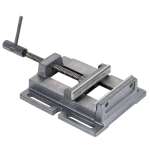
A machine vice for metalworking is a particularly useful workholding accessory for pillar drills, drilling and milling machines, and milling machines.
It holds a workpiece between two jaws to reduce movement during operations compatible with the vice's design.
Several types of machine vice are available to meet different workshop requirements:
- Drilling machine vice: designed to hold workpieces on compatible pillar drills and drilling machines.
- Milling machine vice: intended for milling operations when its construction is suitable for the cutting forces involved.
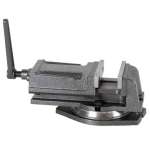
- Swivel base machine vice: allows the orientation of the workpiece to be adjusted using a rotating base.
- Precision machine vice: intended for applications requiring careful positioning, according to the specifications of the model.
Choosing a suitable vice depends on several factors, including jaw width, maximum jaw opening, overall height, mounting dimensions and permissible clamping forces.
It is also important to check the available space on the machine table and the compatibility of the vice with the intended operations.
A vice designed solely for drilling is not necessarily suitable for the lateral cutting forces generated during milling.
For accurate work, the condition of the jaws, the rigidity of the vice and its correct attachment to the machine table are also important considerations.
Machine Table Clamping Kits: Securing Large and Irregular Workpieces
A metalworking machine clamping kit provides an alternative or complementary solution to a machine vice. It allows workpieces to be secured directly to the machine table using several clamping components.
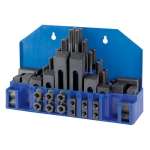
A typical clamping set contains clamping bars, threaded studs, T-slot nuts, clamping nuts and step blocks.
These accessories are particularly useful for securing larger workpieces, metal plates and components whose shape makes conventional vice clamping impractical.
Clamping bars apply pressure to the component, while T-slot nuts provide anchoring points within the machine table slots.
Step blocks are used to adjust the supporting height of the clamping bars according to the thickness of the workpiece.
Before selecting a milling machine clamping kit, it is essential to check the T-slot dimensions and the thread sizes of the fixing components.
A designation such as M10 or M12 generally refers to a metric thread size and must not be confused with the width of the T-slot.
A clamping arrangement must be correctly positioned and tightened to maintain workpiece stability and prevent contact between the clamping components and the cutting tool.
Direct workpiece clamping is a versatile method, but the arrangement must always be suitable for the expected machining forces.
Metalworking Machine Stands and Supports: Improving Workshop Stability
A metalworking machine stand provides a suitable support for certain machines, depending on their dimensions, weight and mounting requirements.
Depending on the model, machine stands may be designed for metalworking lathes, milling machines, pillar drills or other workshop equipment.
A suitable support helps position the machine at an appropriate working height and makes it easier to organise the available workshop space.
Some machine stands also include storage compartments or cupboards for keeping tools and accessories close to the workstation.
However, choosing a machine tool stand that is compatible with the equipment is essential.
The supporting surface dimensions, mounting hole positions, load capacity and manufacturer's installation instructions must all be checked before installation.
A machine stand does not automatically eliminate vibration. Overall stability also depends on the rigidity of the stand, the quality of its fixings, the workshop floor and the characteristics of the machine.
For heavy equipment or machines generating significant forces, the manufacturer's recommendations regarding anchoring and installation must be followed.
Using a correctly sized stand helps create a practical and organised workstation while supporting the machine under appropriate operating conditions.
Cutting Oils and Machine Lubricants: Supporting Metalworking Operations
Cutting oil for metalworking machines is used in certain drilling, tapping, turning, milling and sawing operations to improve the conditions between the cutting tool and the material being machined.
Depending on its formulation and application, a cutting lubricant can help reduce friction, limit heat generation and facilitate certain machining processes.
Different products are available for various workshop applications:
- Neat cutting oil: used for certain machining operations requiring suitable lubrication.
- Water-miscible cutting fluid: designed, depending on its formulation, to be mixed with water for use in compatible coolant systems.
- Drilling and tapping lubricant: developed for the corresponding cutting operations.
- Machine lubricating oil: intended for specific mechanical components when its properties meet the manufacturer's requirements.
It is important to distinguish cutting fluids from lubricants designed for the machine's mechanical components.
A cutting oil should not automatically be used on slideways, gears or spindles. Each mechanical assembly may require a lubricant with specific characteristics.
Before use, check the product's compatibility with the material being machined, the application system and the machine manufacturer's recommendations.
Safety instructions, storage conditions and any dilution requirements must also be followed.
Choosing the correct metalworking cutting fluid helps maintain suitable operating conditions and contributes to the effective use of cutting tools.
Coolant Systems for Metalworking Machines: Cooling and Lubrication During Cutting
A coolant system for metalworking machines delivers cutting fluid to the machining area when the machine and operation are designed for this type of application.
Depending on the equipment, coolant systems may be used on milling machines, drilling and milling machines, metalworking lathes and metal cutting bandsaws.
A typical system may include a pump, fluid reservoir, hoses, adjustable nozzles and suitable connecting accessories.
The fluid is directed towards the cutting area to assist with cooling, lubrication and, depending on the system, chip removal.
A machine tool coolant system must be selected according to the characteristics of the machine and the cutting fluid being used.
Important considerations include mounting possibilities, electrical supply requirements, connection dimensions and compatibility between the system components and the fluid.
Not every machine is designed to accept liquid coolant equipment. Adding such a system requires consideration of electrical component protection, fluid collection and the machine manufacturer's recommendations.
Regular maintenance of the reservoir and coolant circuit helps reduce the risk of blockages and supports reliable operation.
Hoses, nozzles and connections should be inspected periodically to identify leaks, damage or restrictions in the fluid flow.
Precision Measuring Tools for Metalworking: Checking Workpiece Dimensions
Precision measuring tools for metalworking are essential for preparing, checking and inspecting machining operations.
They allow users to measure component dimensions, verify certain machine settings and check whether finished parts meet the required specifications.
Common measuring instruments used in mechanical workshops include:
- Vernier and digital callipers: for measuring external and internal dimensions or depths, depending on the model.
- Micrometers: for accurate dimensional measurements within the instrument's specified measuring range.
- Dial indicators: for checking variations in position, displacement and certain geometric deviations.
- Magnetic indicator stands: for holding compatible dial indicators during measurement and inspection.
- Precision squares: for checking right angles and performing suitable inspection operations.
- Gauges and marking tools: for preparing and checking various metalworking operations.
Choosing a measuring instrument for a mechanical workshop depends on the dimensions to be checked, the required accuracy, the measuring range and the working conditions.
Measuring tools should be used on clean surfaces and under suitable conditions. The manufacturer's recommendations regarding maintenance, verification and calibration, where required, should also be followed.
Reliable measurements contribute to consistent machining results and help identify dimensional deviations before further operations are carried out.
Proper storage is also important to protect delicate measuring surfaces and maintain the condition of precision instruments.
How to Choose the Right Accessories for Your Metalworking Machine
Before purchasing a machine tool accessory, it is important to identify the exact machine model and the operations for which the equipment will be used.
The specifications to check depend on the type of accessory:
- For a machine vice: check the dimensions, jaw opening and mounting arrangements.
- For a clamping kit: verify the T-slot dimensions and thread sizes.
- For a machine stand: check the dimensions, fixing points and maximum load capacity.
- For a replacement shear blade: confirm the machine reference and exact blade dimensions.
- For cutting oil: choose a formulation suited to the material and machining operation.
- For a coolant system: check installation requirements and the characteristics of the fluid circuit.
- For a measuring instrument: consider the measuring range and required accuracy.
The brand and exact model reference of the machine are often essential for determining accessory compatibility.
Two machines with similar power ratings or dimensions do not necessarily use the same equipment.
If there is any uncertainty, the technical specifications of the accessory should be compared with those provided in the machine manufacturer's documentation.
Careful selection helps avoid unsuitable purchases and ensures that the accessory can be used under the intended operating conditions.
Maintaining Metalworking Machine Accessories and Workshop Equipment
Regular maintenance of metalworking machine accessories and equipment helps preserve their functionality and extend their service life.
After machining, metal chips and residues should be removed from machine vices, clamping bars and mounting surfaces.
Threads, clamping mechanisms and supporting points should be inspected for excessive wear or possible damage.
Measuring instruments should be cleaned and stored under suitable conditions to protect their measuring surfaces and internal mechanisms.
Cutting oils and fluids must be stored according to the manufacturer's instructions, avoiding contamination and unsuitable mixing.
Coolant circuits also require periodic inspection, particularly the hoses, connections, nozzles and reservoir.
Machine stands and supports should be checked regularly to ensure that their fixings remain secure and the installation is stable.
All adjustment, cleaning and maintenance operations must be carried out under suitable safety conditions, with the machine stopped and isolated from its power supply whenever the intervention requires it.
Using equipment in good condition is an important part of maintaining a safe and efficient metalworking workshop.
Why Buy Metalworking Machine Accessories from Probois Machinoutils?
Specialising in woodworking and metalworking machinery, Probois Machinoutils offers a range of metalworking machine accessories and equipment designed to complement the installation and use of workshop machinery.
We supply machines and accessories from brands including Holzmann and Bernardo, with solutions for both private users and professionals.
Our selection includes workholding equipment, machine fixing accessories, machining consumables, lubrication systems and precision measuring instruments.
To complete your workshop equipment, explore our categories dedicated to metal lathe tooling, milling accessories, drill bits and drilling equipment.
Whether you want to equip a new machine, replace a worn accessory or improve the organisation of your workshop, choosing metalworking machine accessories compatible with your equipment helps you work under better conditions of accuracy, stability and safety.