Replacement armatures, rotors and stators for machine tool electric motors
Discover our range of armatures, rotors and stators for woodworking machines, metalworking machines and power tools, designed for the repair and maintenance of your equipment's electric motors.
The armature and stator are essential components of an electric motor. Their electromagnetic interaction converts electrical energy into mechanical energy, driving the various moving parts of the machine.
Over time, intensive use, overloading or excessive motor overheating can cause these components to deteriorate. Replacing a faulty armature or stator can therefore provide a cost-effective solution for repairing your machine without replacing the entire motor.
At Probois Machinoutils, we offer replacement armatures and stators for Scheppach, Kity, Woodster, Parkside, Dexter, Manupro, Holzmann, Holzprofi and Leman machines.
Armatures and rotors for Scheppach, Kity and Woodster sliding mitre saws
Sliding mitre saws are particularly demanding on their motors during woodworking, fitting and construction work. Their electric motors must provide sufficient power to drive the saw blade at high speed and produce accurate cuts in various materials.
Intensive use or excessive loads can cause progressive deterioration of the motor armature.
Our range includes replacement armatures for the following models:
- Scheppach HM90LXU.
- Scheppach HM100T, HM100LU and HM100LXU.
- Scheppach HM100MP and HM110MP.
- Scheppach HM110T and HM120L.
- Scheppach HM216SPX.
- Kity MST254, MS254 and MS255.
- Woodster SX10T, SL9LXU and SL10LU.
- Parkside PZKS2000B2.
- Dexter DX254.
We also offer armatures for Holzmann TK305, Holzprofi SRO305 and Leman SOR310 mitre saws, as well as spare parts compatible with various machines marketed under the Parkside, Dexter and Manupro brands.
Before ordering your armature, always check the exact reference of your machine, its serial number and the compatibility information provided on the product page.
Armatures for table saws, plunge saws and scroll saws
Our selection of electrical spare parts also includes armatures for various sawing machines used in woodworking workshops.
- Scheppach HS80 and TS205 table saws.
- Woodster ST8 table saw.
- Scheppach PL55 plunge saw.
- Scheppach DECO 405 scroll saw.
When the motor experiences a loss of power, excessive sparking or operating difficulties, a faulty armature may be the cause of the problem.
Replacing the rotor may restore normal motor operation when the other electrical and mechanical components are in good condition.
Armatures for Scheppach, Parkside and Woodster drywall sanders
Long-reach drywall sanders used for sanding walls and ceilings are particularly exposed to the fine dust generated during renovation and finishing work.
Dust accumulation inside the motor can restrict ventilation and contribute to overheating.
Discover our replacement armatures for Scheppach DS900 to DS935 and DS940 drywall sanders, as well as models compatible with certain Parkside and Woodster sanders.
Depending on the version and manufacturing date of the machine, the armature dimensions, winding specifications and mechanical components may differ.
It is therefore essential to check the compatibility information before selecting your replacement part.
Armatures for metalworking machines, drill presses and demolition hammers
Our range of armatures is not limited to woodworking machines. We also offer replacement rotors for various types of equipment used in metalworking workshops, on construction sites and for DIY projects.
Discover our armatures for:
- Scheppach metal cutting bandsaws, including the MBS1100.
- Scheppach metal cut-off saws, including the MT140.
- Scheppach and Parkside drill presses.
- Scheppach demolition hammers, including the AB1900.
These components allow you to repair the motor of compatible machines when the original armature is damaged.
Replacement stators for Scheppach, Dexter and Parkside mitre saws
In addition to armatures, we offer replacement stators for sliding mitre saw electric motors.
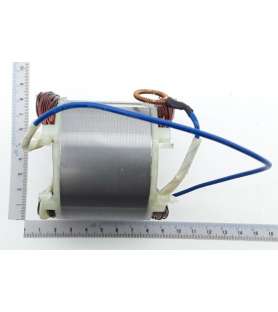
Our selection includes the stator reference 5901220008 for Scheppach HM110MP and Dexter DX254 mitre saws, as well as stators designed for various Scheppach, Dexter, Parkside and Woodster machines.
The stator plays an essential role in generating the magnetic field required for motor operation. When its windings are damaged, the motor may lose power, overheat or stop working completely.
An electrical diagnosis can determine whether the fault originates from the stator, armature, carbon brushes or another component.
What is the difference between an armature, a rotor and a stator?
The terms armature, rotor and stator refer to different components of an electric motor. Their functions depend in particular on the motor technology used.
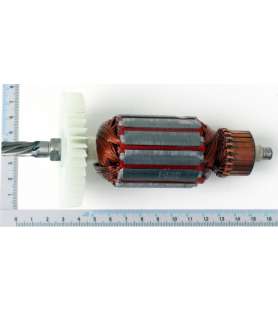
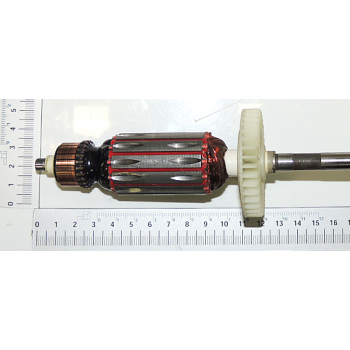
The rotor: this is the rotating part of the electric motor. It transmits mechanical movement to the motor shaft and the components driven by the machine.
The stator: this is the stationary part of the motor. In universal brushed motors, it generally contains field windings that generate the magnetic field required for motor operation.
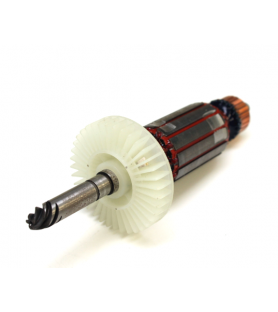
The armature: this is the part of the motor in which electromagnetic interaction contributes to generating motor torque. In universal motors fitted to many machine tools and power tools, the armature is located on the rotor.
In the field of spare parts for brushed electric motors, the terms armature and rotor are therefore frequently used to describe the same mechanical and electrical assembly.
However, these terms are not necessarily interchangeable for all electric motor technologies.
What components make up an electric motor armature?
The armature of a universal brushed motor generally consists of several components that work together to ensure motor rotation.
- A metal shaft that transmits mechanical movement.
- A magnetic core made of laminated metal sheets.
- Insulated copper wire windings.
- A commutator consisting of conductive segments.
- Electrical insulation components.
- A cooling fan, depending on the motor design.
- Bearings or bearing mounting surfaces on the shaft.
- A drive pinion or another transmission system, depending on the machine model.
The carbon brushes make contact with the commutator to transmit electrical current to the armature windings while it rotates.
Damage to any of these components can cause motor malfunction and require replacement of all or part of the assembly.
The components supplied with a replacement armature may vary depending on the reference. Consult each product page to determine exactly what is included.
What is the function of the stator in a brushed electric motor?
The stator is the stationary part of the electric motor. In a universal motor, it generally consists of a magnetic circuit and field windings.
When the motor is powered, these windings generate a magnetic field that interacts with the magnetic field produced by the armature. This interaction creates the torque required to rotate the motor shaft.
The good condition of the stator is essential for proper motor operation.
Damage to its windings may cause:
- Reduced motor torque.
- Loss of machine power.
- Abnormal electrical consumption.
- Excessive motor overheating.
- Deterioration of electrical insulation.
- Tripping of electrical protection devices.
- Complete motor failure.
A faulty stator must be replaced with a component suitable for the electrical and mechanical specifications of the original motor.
How can you tell if your electric motor armature is faulty?
A damaged armature can cause various symptoms during machine operation.
Several signs may indicate that the rotor needs checking:
- The motor produces excessive sparks around the carbon brushes.
- Electrical arcing occurs around the commutator.
- The machine experiences a significant loss of power.
- The motor runs irregularly.
- The rotational speed fluctuates abnormally.
- The motor heats up rapidly during operation.
- A burning smell comes from the motor.
- The carbon brushes wear out unusually quickly.
- The commutator shows signs of burning or excessive wear.
- The copper windings show signs of deterioration.
- The armature bearings have excessive play.
- The motor produces unusual vibrations or noises.
- The machine no longer starts.
- Electrical protection devices trip during operation.
These symptoms do not necessarily mean that the armature is faulty. They may also be caused by worn carbon brushes, a damaged stator, defective bearings or another electrical or mechanical fault.
A complete motor diagnosis is recommended before ordering a replacement part.
Why is your electric motor producing excessive sparks?
Small sparks may appear around the carbon brushes during normal operation of a universal motor.
However, excessive or continuous sparking, or sparks spreading across a large part of the commutator, may indicate a problem requiring attention.
Several factors may explain this phenomenon:
- Excessively worn carbon brushes.
- Carbon brushes unsuitable for the motor.
- Poor contact between the carbon brushes and the commutator.
- Damaged carbon brush holder springs.
- A dirty or damaged commutator.
- A short circuit between turns of the armature winding.
- Deterioration of the stator windings.
- Excessive play in the rotor bearings.
- Accumulation of conductive dust inside the motor.
- Mechanical or electrical overloading.
If excessive sparking occurs together with a burning smell, loss of power or abnormal overheating, stop using the machine immediately and have it inspected.
Continuing to use a motor displaying these symptoms may worsen damage to the armature, stator and other electrical components.
Why does an electric motor armature burn out?
Armatures are subjected to considerable electrical, mechanical and thermal stresses. Although they are designed to operate at high speeds, several factors can reduce their service life.
The main causes of deterioration include:
- Intensive use exceeding the machine's operating capacity.
- Repeated motor overloading.
- Excessive pressure applied to the tool during machining.
- Using a blunt or unsuitable saw blade.
- Insufficient motor ventilation.
- Cooling vents blocked by dust.
- Accumulation of sawdust or abrasive dust.
- Excessively worn carbon brushes.
- Defective or seized bearings.
- A blocked motor shaft or transmission system.
- An unsuitable electrical power supply.
- Deterioration of winding insulation.
- Short circuits between winding turns.
- Natural ageing of electrical components.
It is important to identify the cause of the fault before installing a new armature. If the original cause persists, the replacement component may also become damaged.
How can you tell if your motor stator is faulty?
A damaged stator may cause symptoms similar to those of a faulty armature.
However, certain signs may justify a specific inspection of the stator:
- Blackened or burnt copper windings.
- A smell of burnt insulating varnish.
- Abnormal overheating of the windings.
- A significant loss of motor power.
- An open circuit in a winding.
- An electrical insulation fault.
- Repeated tripping of electrical protection devices.
A visual inspection is not always sufficient to determine the actual condition of the stator. Certain internal electrical faults may not be visible.
Resistance, continuity and insulation tests performed with suitable equipment by a qualified professional can help provide a more accurate motor diagnosis.
Should carbon brushes be replaced at the same time as the armature?
When replacing an armature, it is strongly recommended to check the condition of the motor carbon brushes and their holders.
Carbon brushes provide electrical contact with the armature commutator. Wear, incorrect positioning or incompatibility can cause premature deterioration of the new commutator.
It is particularly advisable to check:
- The remaining length of the carbon brushes.
- The condition of their contact surfaces.
- The pressure applied by the springs.
- The free movement of the brushes inside their holders.
- The condition of the electrical connections.
- The compatibility of the brushes with the new commutator.
When carbon brushes are worn, damaged or have an irregular contact surface, replacement is recommended.
At Probois Machinoutils, discover also our range of motor carbon brushes for Scheppach, Kity, Woodster, Parkside and other compatible brands.
How to choose the correct armature for your electric motor?
When ordering a replacement armature or rotor for a machine tool, it is essential to accurately identify your machine and the specifications of the original component.
Before placing your order, check the following information:
- The machine brand.
- The exact machine model.
- The manufacturer's article number.
- The machine serial number.
- The manufacturing date or year.
- The original armature reference number.
- The motor supply voltage.
- The rated motor power.
- The overall length of the armature.
- The diameter of the magnetic core.
- The commutator diameter.
- The motor shaft dimensions.
- The bearing dimensions and reference numbers.
- The drive pinion specifications, where applicable.
- The cooling system specifications.
Two visually similar armatures may have significant differences in their windings, shaft dimensions, commutators or mechanical transmission systems.
An armature must therefore never be selected solely on the basis of its appearance or external dimensions.
The original manufacturer's reference number and the compatibility information provided on the product page remain the main factors to check before ordering.
Why should you check the manufacturing year of your Scheppach or Parkside machine?
Manufacturers may modify the design of an electric motor during the production life of the same machine model.
Consequently, two mitre saws or drywall sanders bearing the same commercial model name may be equipped with different armatures depending on their manufacturing year or serial number.
These modifications may concern:
- The motor shaft length.
- The armature diameter.
- The commutator diameter.
- The bearing reference numbers.
- The number of teeth on the drive pinion.
- The cooling system.
- The winding specifications.
- The design of the stator and motor housing.
This is particularly important for Scheppach, Kity and Woodster machines, as well as models marketed under various DIY retailer brands.
For certain Parkside machines, it is also important to check the IAN number to accurately identify the version of the equipment.
Before ordering your spare part, consult the machine identification plate and, whenever possible, its exploded parts diagram.
Armatures and stators compatible with several machine brands
Certain machines marketed under different brands may share a similar mechanical and electrical design.
Some armatures and stators are therefore compatible with several models of Scheppach, Kity, Woodster, Parkside, Dexter or Manupro machines.
This compatibility may allow equipment manufactured several years ago to be repaired, even when the spare part is now marketed under another brand.
However, a visual resemblance between two machines does not guarantee that their motors or electrical components are identical.
Only confirmed reference numbers and technical compatibility information can determine whether an armature or stator can be used on another machine model.
How to choose a replacement stator compatible with your motor?
When selecting a replacement stator, the motor design and electrical specifications of the original component must be taken into account.
Several factors must be checked:
- The original stator reference number.
- The machine brand and model.
- The rated motor voltage.
- The electrical specifications of the windings.
- The internal and external dimensions of the stator.
- The length of the magnetic core.
- The position of the mounting points.
- The type of electrical connection.
- Compatibility with the armature installed in the motor.
An unsuitable stator may alter motor operation, cause a loss of power or lead to excessive overheating of electrical components.
Replacement must therefore be carried out using a component whose compatibility with the original motor has been confirmed.
Should you replace only the armature or the complete electric motor?
When an electric motor fails, replacing the entire motor is not always necessary.
If the fault is limited to the armature or stator and the other components are in good condition, replacing the faulty part may provide a more economical solution.
Repairing an electric motor offers several potential advantages:
- Reducing the cost of replacement parts.
- Retaining electrical and mechanical components that are still in good condition.
- Extending the service life of the machine.
- Avoiding premature replacement of the entire machine.
- Reducing electrical and electronic waste.
However, when several motor components are damaged, replacing the complete motor may be a more suitable solution.
It is therefore recommended to compare the cost of the required spare parts, labour and the overall condition of the machine before choosing the most appropriate repair solution.
How to extend the service life of your machine's armature and stator?
Regular maintenance and appropriate use can help reduce the stresses placed on electric motor components.
To preserve your machine, we recommend following several good practices:
- Comply with the machining capacities specified by the manufacturer.
- Avoid prolonged motor overloading.
- Use properly sharpened saw blades and cutting tools.
- Avoid applying excessive pressure during cutting or sanding operations.
- Keep cooling vents clean and unobstructed.
- Use a suitable dust extraction system whenever the machine allows it.
- Regularly check the condition of the motor carbon brushes.
- Check for unusual noises or vibrations.
- Follow the operating and cooling periods recommended by the manufacturer.
- Use an electrical power supply suitable for the machine's specifications.
- Stop using the machine if abnormal overheating or a burning smell occurs.
These precautions help reduce premature wear of the motor windings, commutator, carbon brushes and bearings.
Precautions when replacing an armature or stator
Replacing an armature or stator requires technical knowledge of mechanics and electricity.
This operation must comply with the manufacturer's specifications and preserve the machine's various safety functions.
Before carrying out any work, several precautions must be observed:
- Completely disconnect the machine from its electrical power supply.
- Ensure that no voltage is present.
- Take into account any residual electrical energy that may remain in electrical components.
- Accurately identify the spare part to be replaced.
- Investigate the cause of the motor failure.
- Check the condition of the stator and armature.
- Inspect the carbon brushes and brush holders.
- Check the condition of the bearings and mechanical transmission system.
- Follow the manufacturer's electrical wiring diagram.
- Avoid impacts that could damage the commutator, shaft or windings.
- Follow the manufacturer's assembly and disassembly procedures.
- Retain all protective and safety devices.
- Have the electrical insulation and motor operation checked before returning the machine to service.
We recommend entrusting electrical diagnosis, armature or stator replacement and commissioning checks to a qualified professional.
Repair your electric motors with Probois Machinoutils spare parts
An electric motor failure does not necessarily mean that your machine needs replacing. With suitable spare parts, it is often possible to restore its operation and extend its service life.
At Probois Machinoutils, specialists in spare parts for woodworking machines, metalworking machines and power tools, we offer a wide range of electrical components designed for the maintenance and repair of your equipment.
Discover our replacement armatures, rotors, stators, motor carbon brushes, brush holders, motor start capacitors, motor run capacitors, contactors, switches, fuses, bearings and electric motors.
Whether you need to repair a Scheppach mitre saw, a Parkside drywall sander, a Kity circular saw or a Holzmann machine, discover our spare parts and check their compatibility with your equipment.
Maintain, repair and extend the service life of your machines with our selection of replacement electrical components.