Spare Parts for Holzmann BF16V Milling and Drilling Machine
Are you looking for spare parts for your Holzmann BF16V milling and drilling machine? Probois Machinoutils offers replacement parts currently available to maintain and repair this compact metalworking machine.
The Holzmann BF16V is a compact machine designed for drilling and milling small metal workpieces. With its 350 W motor operating on 230 V, MK3/MT3 spindle taper and variable speed divided into two ranges, it is suitable for workshops, small machining jobs, model making and users looking for a compact milling machine.
Like any machine tool containing moving mechanical components, the BF16V may require replacement of certain parts after several years of use. Gears, transmission components and movement mechanisms must remain in good condition to ensure smooth and reliable operation.
Our range of BF16V spare parts can evolve over time: additional references may be added depending on parts availability and the repair requirements encountered on these machines.
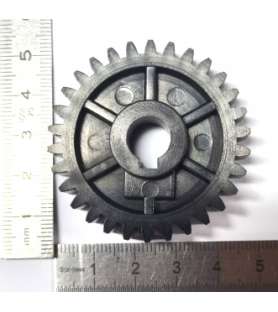
Position 138 Gear for Holzmann BF16V
The main part currently available in this category is the position 138 gear for the Holzmann BF16V milling machine.
This gear has a diameter of approximately 48 mm and a bore of approximately 9.7 mm. It also features a keyway.
It is a specific mechanical component that must be accurately identified before ordering.
Position number 138 allows its location to be identified on the machine's exploded diagram and is an important detail for avoiding confusion with another gear.
Before ordering, always compare the gear fitted to your machine with the dimensions and specifications shown on the product page.
What Is the Purpose of a Gear in the BF16V Milling Machine?
The gears inside a milling and drilling machine contribute to the mechanical transmission of movement between different components.
They must transmit the required force while maintaining smooth and correct meshing.
A damaged gear can cause irregular transmission, knocking noises, drive problems or, depending on its position, prevent movement from being transmitted correctly.
It is therefore important not to continue forcing the machine if an unusual mechanical noise appears.
Continuing to operate a gear with damaged teeth can make the problem worse and potentially damage the components with which it meshes.
When Should the Position 138 Gear Be Replaced?
A gear may need to be replaced when its teeth are broken, heavily marked or abnormally worn.
Damage can also occur following a tool jam or excessive load applied to the transmission.
If the machine suddenly begins making knocking noises or a mechanism no longer operates normally, stop the machine and inspect it before continuing work.
A visual inspection will usually reveal a broken tooth or significant wear.
However, it is also important to determine the cause of the damage to prevent a new gear from suffering the same problem shortly after installation.
Why Can a Milling Machine Gear Become Damaged?
A gear does not necessarily fail simply because of its age.
Excessive machine load can place considerable stress on the transmission.
A cutting tool jamming in the workpiece, an excessive depth of cut, unsuitable spindle speed or excessive feed can suddenly increase the force transmitted through the gears.
Incorrect gear meshing or another component with excessive play can also accelerate wear.
Before replacing a broken gear, it is therefore advisable to inspect the other components around it.
Check the Other Gears Before Reassembly
If a gear has a broken tooth or severe damage, also inspect the gear with which it meshes.
A broken tooth may have marked or damaged the mating gear.
Replacing only the first gear without inspecting the complete mechanism can result in further damage after only a short period of operation.
Also remove any fragments remaining inside the mechanism before reassembly.
Even a small piece of a broken tooth left in the transmission can become trapped between two gears and cause another failure.
Importance of the Gear Keyway
The position 138 gear has a keyway.
A key mechanically locks a rotating component to its shaft so that torque can be transmitted correctly.
When dismantling the assembly, also inspect the condition of the key and its corresponding slot.
A deformed or heavily marked key, or excessive play in the keyway, can affect the transmission.
During reassembly, the gear must be correctly positioned on its shaft and the key must fit normally into its slot without requiring abnormal force.
Check the Bore Before Ordering
The gear offered for the BF16V has a bore of approximately 9.7 mm.
This dimension should be compared with your original component.
The outside diameter, bore, number and shape of the teeth and the keyway are all important characteristics when determining gear compatibility.
A gear with a similar outside diameter is therefore not automatically compatible.
Never select a replacement gear solely on the basis of its appearance.
A Compact 230 V Milling and Drilling Machine
The Holzmann BF16V operates on 230 V / 50 Hz and is equipped with a 350 W motor.
Its compact design provides genuine drilling and milling capabilities without the size and space requirements of a much larger workshop milling machine.
However, its power must be considered in relation to the machine's capacities.
The BF16V is intended for work suited to its size. Excessive depth of cut or the use of an oversized cutting tool can place unnecessary stress on the motor and transmission.
Respecting the machine's capabilities therefore directly contributes to preserving its mechanical components.
MK3 / MT3 Spindle on the Holzmann BF16V
The BF16V uses a spindle with an MK3 / MT3 taper.
This characteristic is important when selecting tool holders, drill chucks and other accessories for the machine.
When installing an accessory, the taper surfaces must be clean.
Metal chips or dirt between the spindle taper and the accessory can prevent correct seating and may cause runout or poor retention.
The spindle and accessories should therefore be cleaned before assembly.
Two Speed Ranges up to 2500 rpm
The Holzmann BF16V features two continuously variable speed ranges:
The correct speed depends particularly on the cutting tool diameter, the material being machined and the type of operation being performed.
A large-diameter drill or milling cutter will generally require a lower speed than a small-diameter tool.
Using an appropriate spindle speed improves cutting conditions and also helps reduce unnecessary stress on the machine.
BF16V Drilling Capacity
The maximum drilling capacity specified for the BF16V is Ø13 mm in steel and Ø16 mm in cast iron.
These figures provide a useful indication of the machine's intended working range.
The BF16V is a compact milling and drilling machine designed for small machining operations rather than an industrial milling machine intended for very heavy material removal.
Respecting the recommended drilling capacities helps reduce unnecessary stress on the motor, spindle and transmission.
Milling Capacity up to Ø30 mm
The BF16V provides a maximum milling diameter of approximately 30 mm.
However, tool diameter is not the only factor that must be considered.
The material being machined, depth of cut, spindle speed and feed rate all directly influence the load placed on the machine.
It is generally preferable to perform several reasonable passes rather than attempting to remove an excessive amount of material in a single operation.
This approach also provides better control of the machining process and reduces stress on the transmission components.
405 x 90 mm Cross Table
The Holzmann BF16V is equipped with a 405 x 90 mm cross table.
This table allows the workpiece to be accurately positioned along the X and Y axes.
Travel is approximately 230 mm on the X axis and 100 mm on the Y axis.
The slideways should be kept clean and correctly adjusted to maintain smooth movement.
Metal chips should be removed regularly, particularly from the guide surfaces and feed screw areas.
185 mm Vertical Travel
The machine also provides 185 mm of Z-axis travel.
The different axes allow the cutting tool to be accurately positioned in relation to the workpiece.
If an axis suddenly becomes unusually difficult to move, do not immediately apply excessive force to the handwheels.
First check for metal chips, slideway adjustment, lubrication and the locking mechanisms.
Forcing a mechanism that is not operating correctly can damage a feed screw, nut or gear.
Milling Head Tiltable from -45° to +45°
The milling head of the BF16V can be tilted from -45° to +45°.
This feature extends the machine's capabilities by allowing certain angled drilling and milling operations.
After changing the head angle, it is important to carefully check that the head is securely locked before starting machining.
For operations requiring high accuracy, repositioning the head may also require an alignment check.
Unusual Gear Noise: What Should You Check?
An unusual noise coming from the transmission should not be ignored.
A repetitive knocking noise can, for example, indicate a damaged tooth on a gear.
A continuous abnormal noise may also result from incorrect gear meshing, insufficient lubrication or excessive play.
Stop the machine before carrying out any inspection.
Operating a transmission for a prolonged period while it is making an abnormal noise can turn a minor repair into a much more serious failure.
The Spindle No Longer Rotates Correctly: Is the Gear Necessarily Responsible?
No. A spindle that no longer rotates correctly does not automatically mean that position 138 gear is broken.
The problem can originate from different components in the transmission or machine controls.
A proper diagnosis should therefore be carried out before ordering the part.
If the gear is accessible, its condition can be inspected visually.
Look particularly for broken teeth, cracks, deformation or unusual play on the shaft.
The BF16V Lacks Power During Machining
A perceived lack of power does not necessarily indicate a motor failure.
Start by checking that the machining conditions are suitable.
A large-diameter milling cutter, excessive depth of cut or excessive feed can require more power than the machine can reasonably provide.
A blunt cutting tool also considerably increases cutting forces.
The spindle speed must be suitable for both the material and the diameter of the cutting tool.
If the problem persists even under normal cutting conditions, a more detailed inspection of the machine may then be necessary.
Importance of Correct Workpiece Clamping
A metal workpiece must always be securely clamped before drilling or milling.
The BF16V has a table with 12 mm T-slots, allowing suitable clamping equipment to be used.
A machine vice or clamping set can be used to hold the workpiece securely during machining.
Never hold a workpiece by hand during a milling operation.
Rigid clamping also improves machining accuracy and helps reduce vibration.
Clean the BF16V Regularly
Metal chips accumulate quickly on a milling and drilling machine.
After use, clean the table, slideways and accessible areas of the machine.
Avoid allowing chips to remain inside the movement mechanisms.
Unpainted metal surfaces can also be protected with a suitable product to help prevent corrosion.
Before carrying out maintenance that requires access to the machine's mechanisms, always disconnect the machine from the power supply.
Lubrication and Maintenance of the Mechanisms
Slideways and mechanical mechanisms must remain correctly maintained.
A dry or dirty guide surface can make movement difficult and accelerate wear.
Use products suitable for machine-tool maintenance and avoid excessive grease build-up that can trap metal chips.
Any gears accessible during a repair should also be inspected to assess their general condition.
Follow the manufacturer's recommendations for specific maintenance operations.
Avoid Overloading the BF16V
The BF16V remains a compact machine with a 350 W motor.
To protect the transmission, the depth of cut should be adapted to the machine's capabilities.
If the spindle slows significantly or the machine begins to vibrate abnormally during an operation, reduce the cutting load.
A properly sharpened tool combined with suitable machining parameters provides better results while reducing mechanical stress.
How to Correctly Identify a Spare Part for the Holzmann BF16V
Before ordering a replacement part, record as much information as possible:
-
Exact model: Holzmann BF16V.
-
Machine serial number.
-
Manufacturing month and year.
-
Information shown on the rating plate.
-
Position number on the exploded diagram.
-
Dimensions of the original component.
-
Bore or shaft diameter.
-
Number and shape of the teeth for a gear.
-
Presence and dimensions of a keyway.
-
Any reference or marking shown on the original component.
For the gear currently offered, pay particular attention to position 138, the approximately 48 mm diameter, approximately 9.7 mm bore and the keyway.
WARNING: BEFORE PURCHASING, make sure your machine is listed in the LIST OF COMPATIBLE MACHINES shown on the spare part product page. Where required, also check the manufacturing month and year and the serial number of your machine.
Visual similarity alone never guarantees the compatibility of a mechanical component.
Do Not Confuse the BF16V with the BF20V or BF25VLN
Holzmann offers several milling and drilling machines whose names and designs may appear similar.
The BF16V should not be confused with the BF20V, BF25VLN or other compact Holzmann milling machines.
The fact that a gear or another component resembles one fitted to another machine does not mean that its dimensions, bore, tooth profile or mounting arrangement are identical.
The exact machine model and the position number of the required component are therefore essential.
Why Repair a Holzmann BF16V Milling and Drilling Machine?
A localised mechanical failure does not necessarily justify replacing the complete machine.
If a gear is damaged while the motor, table, spindle, column and main mechanical components remain in good condition, replacing the affected component can allow the machine to be returned to service.
A targeted repair can therefore significantly extend the service life of the BF16V.
However, it is important to determine the cause of the failure before reassembly so that the new part is not immediately damaged again.
A Range of BF16V Spare Parts That Can Evolve
The Holzmann BF16V spare parts category is designed to evolve according to parts availability and repair requirements encountered on this machine.
Position 138 gear is currently the part offered for this model.
Other references may be added when additional components become available for the repair and maintenance of the BF16V.
This organisation makes it possible to progressively group machine-specific replacement parts in one clearly identifiable category.
Order Holzmann BF16V Spare Parts from Probois Machinoutils
Probois Machinoutils offers spare parts for the Holzmann BF16V metal milling and drilling machine to make maintenance and repair of your machine easier.
You can currently find in this category the position 138 gear, Ø48 mm with an approximately 9.7 mm bore and keyway.
Before ordering, accurately identify your machine and compare the original component with the specifications shown on the corresponding product page.
Probois Machinoutils helps you find suitable spare parts for your Holzmann BF16V so that you can repair your metal milling and drilling machine and extend its service life.