Welding Fume Extraction: Solutions for a Healthier Workshop
Welding operations generate fumes and airborne particles that can present health risks to operators. To limit their dispersion throughout the workshop, it is essential to install a welding fume extraction system suited to the welding processes and working conditions. At Probois Machinoutils, we offer welding fume extraction equipment, including Holzmann solutions, designed for metalworking workshops, maintenance companies, metal fabrication professionals and users wishing to improve their working environment.
A welding fume extractor captures emissions produced during welding operations to help prevent their spread into the surrounding air. Depending on its design, the equipment may include an extraction hood, a filtration system and a fan that generates the necessary airflow. Choosing an appropriate installation helps reduce exposure to airborne contaminants and improve working conditions in the workshop.
Why Is Welding Fume Extraction Important?
When metal is heated to high temperatures during welding, various contaminants can be released into the air. Welding fumes contain fine particles originating from the materials being welded, filler metals and any coatings present on the workpieces.
The composition of these emissions varies according to the welding process, the type of metal, the consumables used and the working conditions. Welding steel, stainless steel or certain coated metals can generate hazardous substances requiring appropriate preventive measures.
Welding fume extraction at source captures emissions as close as possible to the point where they are produced, before they spread throughout the working environment. This approach is particularly important for reducing the operator's direct exposure.
However, installing an extraction system does not eliminate the need for workplace risk assessments, suitable ventilation and the protective measures recommended for each welding process.
How Does a Welding Fume Extractor Work?
A welding fume extractor generally operates using a fan that creates negative pressure, allowing contaminated air to be captured near the welding workstation.
Depending on the installation, fumes can be collected through an extraction hood, an articulated extraction arm, a capture nozzle or a device integrated into the welding equipment. The captured air is then directed towards a filtration system or discharged outdoors, depending on the installation design.
A welding fume extractor with filtration may contain different filter elements designed to retain certain airborne particles. The effectiveness of the treatment depends on the filtration technology, filter characteristics, airflow rate and nature of the contaminants.
It is important to remember that not all filtration systems are suitable for every type of pollutant. Filters designed to capture particles do not necessarily remove gases generated during certain welding operations.
Before selecting equipment, the manufacturer's technical specifications should therefore be checked to ensure that the system is suitable for the identified workplace hazards.
Mobile Welding Fume Extractor: A Flexible Workshop Solution
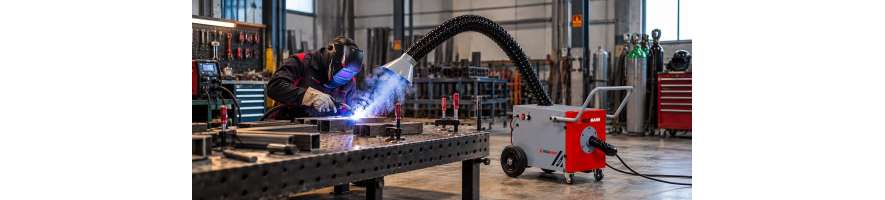
A mobile welding fume extractor is particularly useful when welding operations are carried out in different areas of the workshop. Unlike a fixed extraction installation, it can be moved closer to the workstation, provided that its design allows this type of use.
This equipment is especially suitable for maintenance workshops, small metal fabrication companies and multipurpose working environments where several welding stations are used at different times.
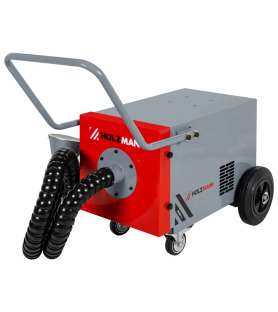
A portable welding fume extraction system may feature wheels, an adjustable extraction arm and an integrated filtration unit. However, these characteristics vary between models and should always be checked in the product specifications.
Mobility makes it easier to position the equipment according to the work being performed. Nevertheless, extraction effectiveness depends on the distance between the emission source and the extraction opening, as well as the air movements present in the surrounding environment.
Welding Fume Extraction Arm: Capture Emissions at Source
A welding fume extraction arm is a capture device designed to position an extraction opening close to the welding area. Depending on its construction, it may be articulated and adjustable to accommodate different operations performed on metal workpieces.
The main advantage of a welding extraction arm is that it facilitates localised collection of airborne contaminants. When correctly positioned and connected to a suitable extraction system, it helps limit the dispersion of welding fumes throughout the workshop.
The length of the arm, its diameter, ease of adjustment and compatibility with the extraction unit are important considerations when selecting equipment.
The position of the extraction opening must also take into account access to the workpiece, the welder's working posture and the requirements of the welding process. Incorrect positioning can significantly reduce the effectiveness of the extraction system.
Welding Fume Filtration: The Importance of Suitable Filters
Welding fume filtration is an important part of extraction systems designed to retain airborne particles before the air is discharged or, where permitted and technically appropriate, returned to the workshop.
Depending on the equipment, different filtration technologies may be used, including pre-filters, particulate filters, filter cartridges and specialised filtration systems. Each technology has specific characteristics regarding particle retention, resistance to clogging and maintenance requirements.
A filter for a welding fume extractor must be compatible with the exact equipment model. Its performance must also correspond to the contaminants being treated and the requirements of the installation.
A clogged filter can reduce airflow and compromise extraction effectiveness. It is therefore essential to follow the inspection and replacement intervals recommended by the manufacturer.
Maintenance operations must be performed with appropriate precautions, as the dust and residues collected inside filters may themselves present health hazards.
Welding Fume Extraction for MIG/MAG, TIG and MMA Welding
The requirements for welding smoke extraction vary according to the welding process. MIG/MAG welding, TIG welding and MMA stick welding do not necessarily produce the same quantities or types of emissions.
During MIG/MAG welding, the fumes generated depend on factors such as the base metal, filler wire, shielding gas and welding parameters. A suitable extraction system should be selected according to the actual working conditions.
MMA welding, also known as stick welding, can generate substantial amounts of fumes due to the melting of the electrode and its coating. Capturing emissions close to the welding area is therefore an important preventive measure.
TIG welding generally produces fewer particulate fumes than certain other welding processes, but it can still generate hazardous contaminants, including gases. It should therefore never be considered free from respiratory risks.
Choosing a fume extractor for a welding machine requires consideration of the welding process, materials, frequency of use and the workplace risk assessment.
How to Choose a Welding Fume Extraction System
When looking to buy a welding fume extractor, several technical characteristics should be examined to select equipment suited to the workshop.
The first consideration is the extraction airflow rate, generally expressed in cubic metres per hour. It must be sufficient to provide effective capture under the intended operating conditions, but airflow alone cannot determine the overall performance of an extraction installation.
Available static pressure, pressure losses within the ducting and the distance between the extraction opening and the source of fumes also influence system performance.
The filtration technology is another essential consideration. It is important to verify which contaminants the system is designed to capture and the operating conditions specified by the manufacturer.
Ease of maintenance, availability of replacement filters, equipment dimensions, noise levels and mobility may also influence the choice.
Finally, it is necessary to determine whether the installation will serve a fixed welding station, be moved between different working areas or form part of a centralised workshop ventilation and extraction system.
Holzmann Welding Fume Extraction: Equip Your Metalworking Workshop
Holzmann offers various products designed for metalworking workshops, including equipment intended for welding fume extraction.
These systems can complement an installation consisting of welding machines, welding tables and metalworking accessories. They make it possible to consider the capture of airborne emissions when planning and organising a welding workstation.
At Probois Machinoutils, we recommend consulting the technical specifications of each Holzmann welding fume extractor to check its intended applications, airflow performance, filtration system and any accessories included.
Technical characteristics and performance vary according to the model. It is therefore important to select equipment that meets the actual requirements of your activities and the contaminants that need to be captured.
Maintenance of a Welding Fume Extractor
A workshop welding fume extraction system requires regular maintenance to maintain suitable operating performance. Maintenance procedures must be carried out in accordance with the manufacturer's instructions.
Important checks include the condition of the filters, the absence of obstructions in the ducting, correct fan operation and the integrity of the extraction components.
A reduction in airflow, unusual operating noise or ineffective fume capture may indicate clogged filters, an obstruction or a technical fault requiring attention.
Consumables should be replaced using compatible parts and appropriate procedures to limit exposure to the collected dust and contaminants.
Proper maintenance helps preserve equipment performance, but it should be accompanied by checks of actual extraction effectiveness in accordance with the requirements applicable to the installation.
Local Exhaust Ventilation and General Workshop Ventilation
Local exhaust ventilation for welding fumes and general workshop ventilation perform different functions. Local extraction aims to capture contaminants as close as possible to their point of generation, while general ventilation contributes to air renewal throughout the building.
General ventilation alone does not necessarily replace a suitable source extraction system. Welding fumes may pass through the welder's breathing zone before being diluted or removed from the workshop.
For professional workshops, the design and installation of a welding fume extraction system should form part of an overall occupational risk prevention strategy, in accordance with applicable regulations.
The possibility of returning filtered air to the workshop must also be assessed separately. This depends on the contaminants present, the performance of the filtration system and the relevant regulatory requirements.
Improve Welding Workshop Air Quality with Suitable Extraction Equipment
Installing an appropriate industrial welding fume extractor can contribute to improving air quality and reducing the dispersion of airborne particles in metalworking environments.
For occasional welding operations, a compact extraction solution may be worth considering, provided that its capture performance and filtration characteristics meet the identified requirements.
For workshops carrying out regular or intensive welding operations, the extraction installation may require a more comprehensive approach involving several capture points, suitable airflow management and professional assessment of the working environment.
The choice between a mobile extractor, a fixed extraction arm and a centralised system depends on the number of workstations, the welding processes, the workshop layout and the characteristics of the emissions.
In every case, effective welding fume control requires suitable equipment, correct positioning, regular maintenance and appropriate operating procedures.
Buy Your Welding Fume Extractor at Probois Machinoutils
Specialising in woodworking machines, metalworking equipment and workshop tools, Probois Machinoutils offers equipment for organising your workshop, including Holzmann welding fume extraction systems.
Whether you are looking for a welding fume extractor, a mobile extraction solution or filtration equipment for your workstation, our catalogue allows you to explore the technical characteristics of the available models.
We also offer complementary metalworking equipment, including welding machines, plasma cutters, welding tables, welding carts and various accessories for organising your workshop.
Before ordering, carefully consult the product specifications to verify the airflow rate, filtration technology, dimensions, installation requirements and any included accessories.
Our team is available to provide information about our equipment and help you identify a welding fume extraction solution suited to your workshop. For professional installations, a technical risk assessment remains essential to validate respiratory protection measures and extraction system design.
Discover our selection of welding fume extractors at Probois Machinoutils and equip your workshop with solutions designed to improve the capture of airborne emissions during welding operations.