
Sorry for the inconvenience.
Search again what you are looking for



Search again what you are looking for
Whether you are a professional metalworker, craftsman, mechanic, maintenance technician or DIY enthusiast, having reliable welding equipment is essential for joining, repairing, manufacturing and transforming metal components. From simple repairs to the construction of more complex metal structures, every operation requires suitable, dependable and correctly specified machinery.
At Probois Machinoutils, we offer a range of welding machines, plasma cutters, welding tables, accessories and protective equipment designed to meet the requirements of fabrication workshops, construction professionals, industrial maintenance teams and private users.
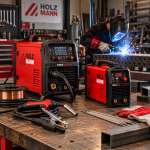
Our Welding Equipment and Welding Machines category brings together the main types of equipment required for preparing, cutting and joining metal components. You can therefore equip your workshop with solutions suited to your activities, from choosing the right welding machine to installing suitable welding fume extraction equipment.
Choosing a welding machine mainly depends on the materials to be joined, their thickness, the preferred welding process and the frequency of use. Not all welding machines are designed for the same applications. Some prioritise ease of operation, while others provide more advanced settings for demanding technical work.
The main arc welding processes used in workshops include MIG/MAG welding, TIG welding and MMA stick welding.
Before selecting a machine, it is important to consider the welding current, duty cycle, power supply requirements, material thickness and compatibility with the necessary accessories.
A machine designed for occasional repairs on small components may not be suitable for intensive use in a professional metal fabrication workshop.
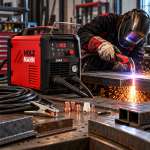
A MIG/MAG welding machine is particularly appreciated for its versatility and ability to produce consistent welds on many types of metal components. This process uses a continuously fed consumable wire electrode supplied automatically through the welding torch.
Depending on the wire and welding process, the molten weld pool may be protected by an external shielding gas. MIG/MAG welding is widely used in metal fabrication workshops, structural manufacturing, automotive repairs and various assembly operations.
A correctly adjusted MIG/MAG welder provides good productivity and makes it possible to produce continuous weld beads. However, the welding wire, shielding gas and machine settings must be selected according to the metal being welded.
For users looking for greater versatility, some multi-process welding machines can also operate using several welding techniques, within the capabilities specified by the manufacturer.
A TIG welding machine is designed for applications requiring precise control of the electric arc and molten weld pool. It uses a non-consumable tungsten electrode and a suitable shielding gas.
This process is particularly suitable for carefully finished joints, thin metal components and applications requiring accurate control of heat input.
TIG welding can be used on different metals, including steel and stainless steel. For aluminium welding, it is necessary to choose equipment and operating modes compatible with this application.
TIG welders differ in their adjustment capabilities, arc ignition functions, current types and welding performance.
For workshops carrying out precision metalworking, choosing a suitable TIG welding machine helps improve control over the welding process and achieve consistent results.
An MMA welding machine, also known as a stick welder or manual metal arc welding machine, is a popular solution for many repair, maintenance and metal fabrication applications.
This process uses a consumable coated electrode whose metal core provides the filler material. The electrode coating helps protect the molten weld pool during welding.
MMA stick welders are commonly used for joining steel components, repairing metal structures and carrying out various fabrication jobs both on-site and in workshops.
Using this process requires electrodes suited to the base metal, workpiece thickness, welding position and technical characteristics of the machine.
Compact inverter welding machines are particularly popular because of their reduced size and ease of transportation.
Before joining metal components, cutting and preparing the workpieces is often necessary. A plasma cutter provides an effective solution for cutting various electrically conductive metals.
A plasma cutting machine uses a plasma arc to separate metal. Depending on the capabilities of the equipment, it can be used to cut steel, stainless steel and aluminium.
Choosing a plasma cutting machine depends on the thickness of the materials, the required cutting quality, the available electrical supply and the compressed air requirements.
It is also important to distinguish between the recommended cutting thickness and the maximum cutting capacity advertised by the manufacturer, as these figures do not necessarily correspond to the same working conditions.
Combined with a welding machine, a plasma cutter allows workshops to carry out a wide range of metal fabrication and repair operations.
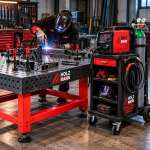
A suitable welding table makes it easier to prepare, position and assemble metal components. It is an important part of creating a stable and functional welding workstation.
Depending on the model, welding tables may feature perforated work surfaces designed for use with clamps, stops and other workholding accessories.
When choosing a welding workbench, consider its dimensions, load capacity, construction and the types of components to be handled.
A welding cart helps transport and organise certain welding equipment. Depending on its configuration, it may accommodate a welding machine, accessories and, where suitable securing devices are provided, a compatible shielding gas cylinder.
A well-organised workshop reduces unnecessary handling and keeps essential equipment within easy reach.
Welding operations can generate welding fumes containing substances that may be hazardous to health. Their composition depends on the welding process, the metals being worked, the consumables used and any coatings present on the components.
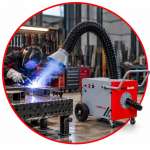
A welding fume extraction system helps capture emissions close to their source when the equipment is correctly selected, positioned and operated.
Different extraction solutions are available, including mobile extraction units equipped with flexible extraction arms and installations designed for specific workstations.
Choosing a welding fume extractor depends on the activity, workshop layout, required airflow and characteristics of the pollutants to be captured.
Filtration and ventilation must be adapted to the identified risks. General workshop ventilation alone does not necessarily replace effective extraction at the source.
For both professionals and DIY users, controlling exposure to welding fumes should be an integral part of welding workstation planning.
The quality of a welded joint also depends on selecting suitable welding consumables. These products include filler materials and components that wear during normal equipment operation.
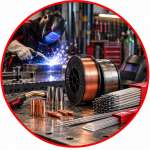
Common consumables include MIG/MAG welding wires, MMA coated electrodes, TIG filler rods, tungsten electrodes and welding torch wear parts.
Welding nozzles, contact tips, collets and other components must be compatible with the equipment being used.
An unsuitable or damaged consumable may cause ignition difficulties, arc instability or irregularities during welding.
It is therefore important to inspect these components regularly and follow the manufacturer's recommendations regarding selection, operation and storage.
Welding accessories help simplify the preparation and assembly of metal components.
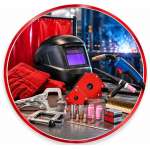
Welding magnets, magnetic welding squares, clamps and workholding devices can be used to position or secure certain components before joining them.
Welding torches and connection accessories must be selected according to the specifications of the welding machine and the process being used.
Welder protection is equally important. Welding operations expose users to hazards including arc radiation, molten metal spatter, heat and electrical risks.
The choice of a welding helmet, suitable gloves, protective clothing and welding screens must take into account the identified hazards and applicable safety standards.
Personal protective equipment should be used alongside collective preventive measures, including welding fume control, protection of nearby personnel and fire prevention.
To choose the right welding equipment, begin by identifying the operations you intend to perform: occasional repairs, steel profile assembly, structural fabrication, maintenance or regular production work.
Frequency of use is another important consideration. For intensive applications, particular attention should be paid to the machine's duty cycle, performance and cooling characteristics.
The electrical supply is also essential. Some machines operate on a 230 V single-phase power supply, while others require 400 V three-phase power.
It is important to check that the electrical installation is compatible with the selected machine, particularly in terms of available power and electrical protection.
Workpiece dimensions, available workshop space, mobility requirements and necessary accessories should also be considered.
Finally, the availability of compatible consumables and replacement parts is an important factor for equipment maintenance and continued operation.
At Probois Machinoutils, our aim is to help you select machinery and equipment suited to your actual requirements, whether you are setting up your first workshop or expanding an existing professional installation.
Our business specialises in woodworking and metalworking machinery, workshop equipment, accessories and spare parts.
We place particular importance on product specifications, equipment compatibility and practical advice to help customers make informed purchasing decisions.
Our range of welding equipment forms part of a wider selection of machinery and accessories designed for fabrication and maintenance workshops, including complementary equipment for metalworking operations.
Whether you are looking for a MIG/MAG, TIG or MMA welding machine, a plasma cutter, a welding table, an extraction system or accessories for your workshop, you can explore the different product families available in our catalogue.
Our team is available to provide information about machine specifications and help you identify solutions suited to your technical requirements.
Whether your project involves repairing a metal component, manufacturing a gate, assembling steel profiles or equipping a metal fabrication workshop, choosing the right welding equipment directly influences the operations you can carry out.
A suitable welding machine, compatible accessories, a functional work surface and appropriate protective equipment form the basis of a well-planned workshop installation.
Explore our dedicated categories to discover welding machines, plasma cutters, welding tables and carts, welding fume extraction systems, welding consumables and welding accessories and protective equipment.
With Probois Machinoutils, equip your workshop for welding, cutting, assembly and metal fabrication projects with solutions suited to your level of use and technical requirements.