Roller Stands and Ball Transfer Stands: Essential Supports for Long Workpieces
A roller stand or ball transfer stand is a particularly useful workshop accessory for supporting and guiding long workpieces during sawing, planing, thicknessing and metalworking operations.
These stands provide an additional support point at the infeed or outfeed side of a machine, helping workpieces move smoothly during machining.
In woodworking, cabinetmaking and metalworking workshops, handling boards, panels, profiles and tubes can become difficult when their length exceeds the available machine table.
An adjustable roller stand allows the support height to be matched to the machine being used, providing additional support as materials enter or leave the working area.
At Probois Machinoutils, we offer a selection of roller stands and ball transfer stands from Holzmann and Bernardo, designed for a variety of workshop applications.
Our range includes single roller stands, multidirectional ball transfer stands, combined roller and ball supports, V-shaped roller stands for tubes and multifunction workshop stands.
These accessories are suitable for woodworking and metalworking professionals as well as DIY enthusiasts looking to improve their workshop organisation.
Why Use a Roller Stand in Your Workshop?
When a wooden or metal workpiece extends significantly beyond the table of a machine, its weight can make handling more difficult.
A workshop roller stand provides additional support for the section of material extending beyond the machine's working surface.
The roller rotates in the direction of movement, allowing the workpiece to travel along the support as it enters or leaves the machine.
This type of equipment is particularly useful when working with long boards, battens, timber sections and metal profiles.
A roller stand can be positioned near a table saw, bandsaw, thickness planer or certain metalworking machines.
It helps organise the workstation and reduces the need to manually support long materials throughout the operation.
However, a roller stand does not replace the safety devices, guides or workpiece-holding systems specified by the machine manufacturer.
It must be positioned correctly and must never cause the workpiece to lift, tilt or become trapped during machining.
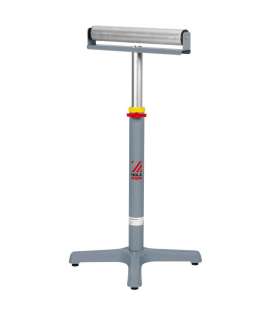
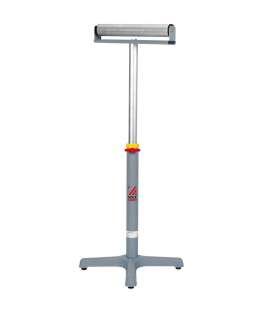
Single Roller Stand: Support Workpieces Along Their Feed Direction
The single roller stand is one of the most commonly used types of workshop support.
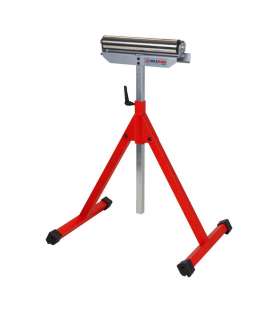
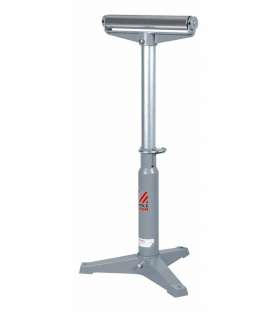
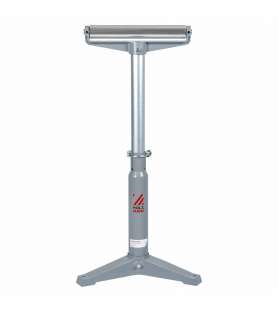
It generally consists of a height-adjustable frame fitted with a horizontal roller designed to support materials.
The roller turns as the workpiece moves along its main feed direction.
This arrangement is particularly suitable for operations where materials travel in a relatively straight line.
The Holzmann S5701 is a roller stand designed to support long workpieces, with a stated maximum load capacity of 80 kg.
The Bernardo FRS-1 provides another adjustable roller support solution, also rated for loads of up to 80 kg.
These models can be used in different workshop configurations, provided that their dimensions, load limits and the manufacturer's instructions are respected.
Choosing a roller stand for woodworking machinery mainly depends on the weight of the materials, the required working height and the stability needed.
A correctly selected stand can make handling longer workpieces more convenient while keeping the workshop organised.
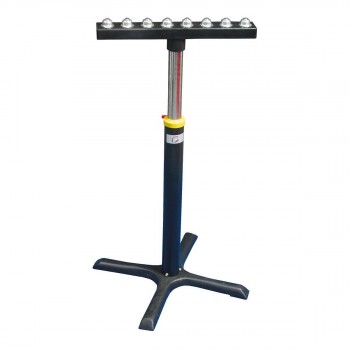
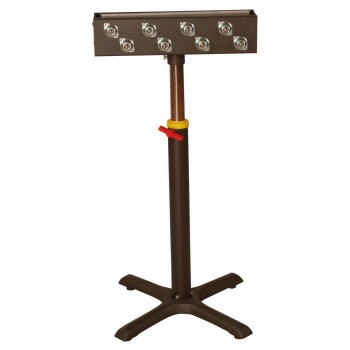
Ball Transfer Stand: Make Multidirectional Movement Easier
Unlike a conventional roller, a ball transfer stand allows workpieces to move in several directions.
The metal ball transfer units rotate freely, helping materials change direction when this is appropriate for the operation being performed.
This feature can be particularly useful when handling certain panels or workpieces requiring lateral adjustments.
A ball transfer stand may be used as an additional support near woodworking machinery or material preparation stations.
The Holzmann S1609 is a multidirectional ball transfer stand with a stated maximum load capacity of 60 kg.
It is designed to support compatible workpieces while allowing movement both lengthways and sideways.
A ball transfer stand for woodworking can therefore offer greater flexibility than a conventional roller support when the workpiece does not move exclusively in a straight line.
However, the type and condition of the material surface must be considered.
The contact points of the metal balls may not be suitable for every workpiece, particularly where surfaces are delicate or easily marked.
Selecting the appropriate support helps maintain suitable handling conditions for the materials being processed.
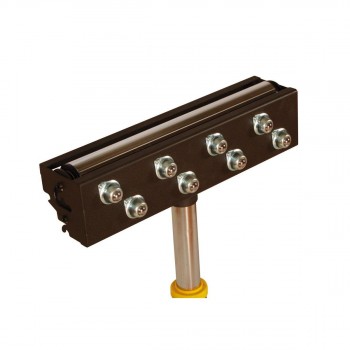
Combined Roller and Ball Transfer Stand: Two Functions in One Support
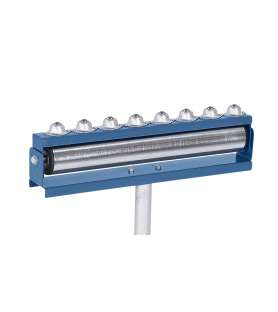
A combined roller and ball transfer stand brings together two different supporting systems to accommodate various workshop applications.
Depending on the model, users can select a conventional roller for lengthwise movement or ball transfer units for multidirectional handling.
This versatility is particularly interesting in workshops where several machines or different types of materials are used.
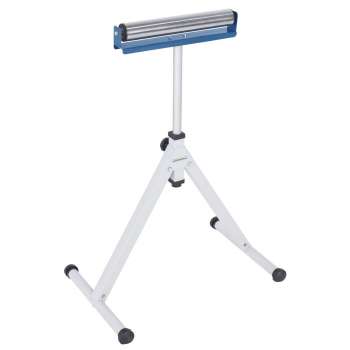
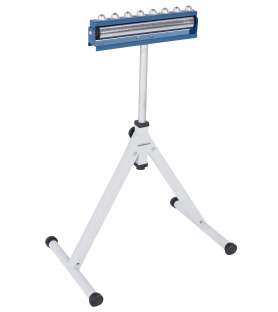
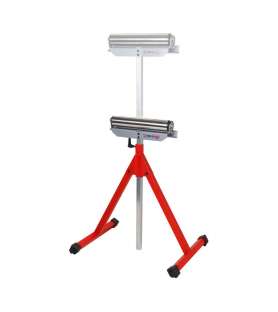
The Holzmann S400RK is a combined stand with an adjustable working height, allowing it to be positioned for different workstation configurations.
The Bernardo CFRS-8 also combines roller and ball transfer functions.
Its folding design and relatively lightweight construction make it particularly interesting for users who need to store or reposition their workshop equipment regularly.
These models offer two support functions without requiring separate stands for every application.
Before use, it is important to select the appropriate configuration and check that the mechanism is correctly positioned or locked according to the manufacturer's instructions.
A combination roller and ball stand can be a practical choice for workshops where flexibility and space-saving equipment are priorities.
3-in-1 Roller Stand: A Versatile Workshop Solution
For workshops carrying out a wide variety of operations, a multifunction roller stand can be a particularly useful accessory.
Some models combine several supporting systems within a single structure.
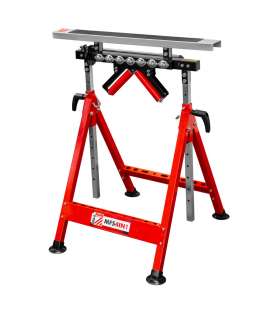
The Holzmann S3IN1 is a three-function workshop stand designed to accommodate different applications.
Depending on the selected configuration, it provides a roller support, ball transfer support and a fold-down supporting surface.
This design allows users to choose the contact surface best suited to the material and operation.
The roller is particularly useful for supporting workpieces travelling in their feed direction.
The ball transfer units can facilitate changes of direction.
The additional supporting surface provides another option for specific handling requirements.
A 3-in-1 roller stand is especially useful in multipurpose workshops where available space is limited.
It provides several possible applications while requiring only one piece of equipment.
4-in-1 Roller Stand: Roller, Ball Transfers and V-Shaped Support
A 4-in-1 roller stand offers additional possibilities for supporting different types of materials.
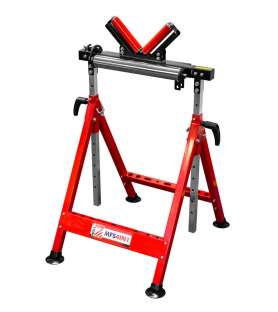
The Holzmann MFS4IN1 combines four functions: a fixed support, a roller support, ball transfer units and a V-shaped support designed particularly for cylindrical workpieces.
This versatility can be especially useful in workshops working with both wood and metal.
Boards and flat profiles may require a conventional horizontal supporting surface, while tubes and round bars can benefit from a V-shaped arrangement.
The appropriate configuration depends on the material, its shape and the intended movement.
A multifunction workshop stand can therefore reduce the number of individual supports needed in the workshop.
It is a practical option for users looking for equipment that can be adapted to several machines and applications.
Before each operation, the selected supporting configuration should be checked to ensure that it is appropriate for the workpiece.
V-Roller Stand: Supporting Tubes and Round Workpieces
Tubes, round bars and certain metal profiles require support suited to their shape.
A conventional horizontal roller may not provide the same guidance as a system specifically designed for cylindrical materials.
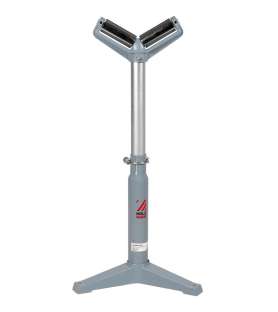
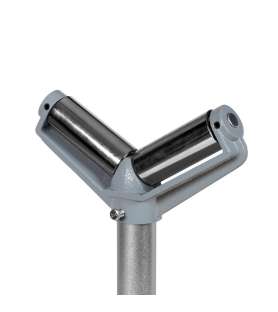
A V-roller stand uses angled rollers arranged to form a cradle for supporting these types of workpieces.
The Holzmann SS52V is designed to support round materials and tubes.
It features two rollers arranged in a V configuration, each with a stated length of 125 mm.
This type of stand can be useful near certain metal-cutting bandsaws or other machines used to process cylindrical materials.
A V-shaped roller support can help position long round workpieces while providing a contact arrangement suited to their geometry.
However, the diameter, weight and stability of the material must always be checked before starting work.
The stand should be positioned to support the workpiece without interfering with machine guidance or normal operating conditions.
Heavy-Duty Roller Stand: Choose a Robust Supporting Structure
Not all workshop roller stands are designed for the same loads.
A small stand used for supporting lightweight battens or boards may not be suitable for a workshop handling heavy metal sections or substantial timber components.
For these applications, choosing a heavy-duty roller stand with an appropriately designed structure is essential.
The Holzmann SS52 is a robust roller stand intended for supporting long and heavy workpieces, with a stated maximum load capacity of 200 kg.
It may be suitable for various cutting and material preparation workstations.
Load capacity is an important selection criterion, but it should not be considered in isolation.
The stability of the frame, adjustment height, weight distribution and workpiece position must also be taken into account.
Materials must never be dropped onto the stand or used in a way that exceeds the manufacturer's specified limits.
For particularly heavy materials or applications requiring support over a greater distance, a roller conveyor may be a more appropriate solution.
Which Roller Stand Should You Choose for a Bandsaw, Planer or Table Saw?
Choosing a roller stand for woodworking machinery depends on the machine being used and the characteristics of the materials.
For a thickness planer, a roller stand can provide additional outfeed support when processing long boards.
It must be adjusted and positioned so that it does not interfere with the normal contact between the timber and the machine tables.
For a table saw, a roller stand can help support certain long workpieces without replacing the machine's guides and safety equipment.
For a woodworking bandsaw, the most suitable support depends on the shape and dimensions of the material.
A metal-cutting bandsaw used for tubes or metal profiles may require a robust roller stand or a V-shaped support, depending on the workpiece.
A ball transfer stand may also be useful for certain material handling or panel positioning operations.
In every case, the stand must be compatible with the machine and with the actual direction of workpiece movement.
How to Choose the Right Roller or Ball Transfer Stand
Before purchasing an adjustable roller stand, several characteristics should be checked.
The first is the maximum load capacity.
It must be suitable for the weight actually supported by the stand, taking into account the manufacturer's specified operating conditions.
The second is the height adjustment range.
The stand must be adjustable to an appropriate height relative to the machine table.
The third criterion is the type of support: single roller, multidirectional ball transfers, V-shaped rollers or multifunction configuration.
The stability of the frame is also important, particularly when handling long or heavy materials.
Finally, overall dimensions and storage requirements may influence the choice.
A folding roller stand can be especially practical in a small workshop, while a more robust model may be better suited to applications requiring higher load capacity.
Comparing these features makes it easier to select a workshop roller stand suited to the intended work.
What Is the Difference Between a Roller Stand and a Roller Conveyor?
A roller stand and a roller conveyor perform complementary functions, but their construction and applications are different.
A roller stand generally provides a single support point for a workpiece at a specific location.
It is usually compact, height-adjustable and easy to reposition around the workshop.
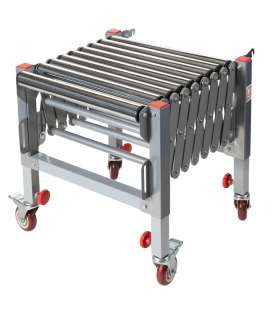
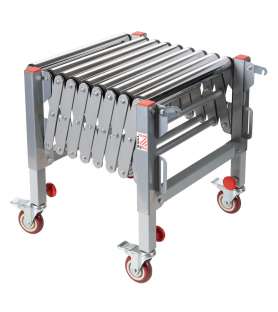
A roller conveyor, on the other hand, consists of a longer structure fitted with multiple rollers distributed along its length.
It provides support over a greater distance and can be particularly useful for machine infeed and outfeed applications.
Roller conveyors may also be used for material handling, preparation and transfer operations.
For occasional or localised support, a roller stand or ball transfer stand is often a practical choice.
For supporting materials over a longer distance, a roller conveyor may be more suitable.
The correct choice therefore depends on the length and weight of the workpieces, the available space and the type of operation.
Installing and Using Workshop Roller Stands Correctly
A roller stand or ball transfer stand must be correctly installed before each use.
The frame should rest on a sufficiently level, stable and load-bearing floor.
The height must be adjusted according to the machine and the intended position of the workpiece.
It is important to check that the rollers or ball transfer units move correctly and that all adjustment mechanisms are securely tightened.
Long workpieces must be handled carefully to prevent tipping or uncontrolled movement.
A roller stand must not be used as a step, lifting device or for any application not intended by its manufacturer.
Regular maintenance helps remove dust, wood shavings and other residues that could interfere with roller or ball movement.
It is also advisable to inspect the frame and fastening components periodically.
These precautions help maintain the stand in good working condition and ensure that it remains suitable for workshop applications.
Holzmann and Bernardo Roller Stands at Probois Machinoutils
At Probois Machinoutils, we offer a range of roller stands and ball transfer stands for workshops designed for woodworking, cabinetmaking and metalworking applications.
Our selection includes Holzmann and Bernardo roller stands, multidirectional ball transfer supports, folding stands and multifunction models.
Available models include the Holzmann S1609, S400RK, S5701, S3IN1, MFS4IN1, SS52 and SS52V, together with the Bernardo FRS-1 and CFRS-8.
Whether you are looking for a roller stand for a thickness planer, a ball transfer support for long workpieces, a V-roller stand for tubes or a multifunction model, you can compare the available products according to their load capacity, height adjustment and construction.
Discover our selection of workshop roller stands and ball transfer stands to create a more practical, functional and well-organised working environment suited to your machinery.