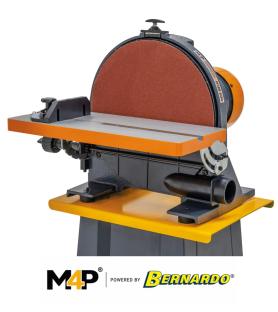
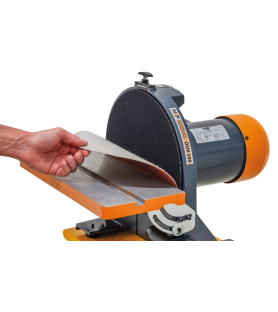
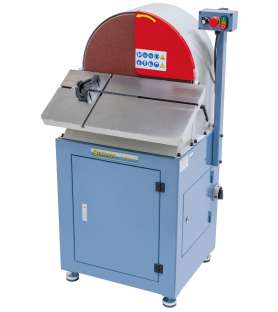
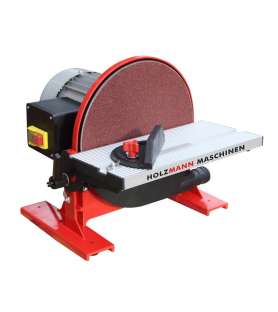
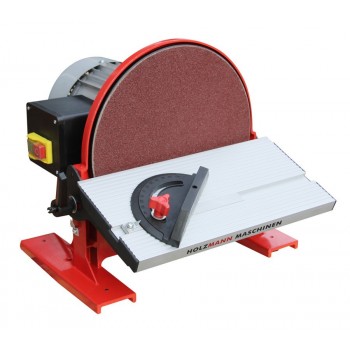
Stationary Disc Sanders for Woodworking
A stationary disc sander is a workshop machine designed for accurate sanding of wooden workpieces. Equipped with a circular abrasive disc driven by an electric motor, it allows users to sand edges, ends, angles and small surfaces with consistent results.
At Probois Machinoutils, we offer a selection of woodworking disc sanders suitable for DIY enthusiasts, woodworking hobbyists, craftsmen and professional workshops. Discover machines from recognised brands such as Holzmann and Bernardo.
What is a disc sander used for?
A disc sander is particularly useful for finishing, shaping and adjusting wooden workpieces. Its rotating abrasive disc gradually removes material to achieve an even surface and a clean finish.
It is especially suitable for:
- Sanding edges and ends of wooden workpieces.
- Adjusting angles before assembling wooden components.
- Shaping small workpieces and performing finishing operations.
- Sanding external curves and contours on wooden parts.
- Smoothing rough edges after cutting, in accordance with the manufacturer's operating instructions.
Why choose a stationary disc sander?
Unlike a handheld sander, a benchtop disc sander remains stationary during operation. The user guides the workpiece against the rotating abrasive disc while supporting it on the worktable.
This design offers several advantages:
- Improved stability when sanding small wooden parts.
- An adjustable sanding table on equipped models, making angled sanding easier.
- Controlled material removal thanks to the choice of abrasive grit.
- Versatile operation for shaping, fitting and finishing wooden components.
- Compact dimensions on models designed for installation on a workbench.
How to choose the right disc sander for woodworking
Several technical features should be considered when choosing a disc sanding machine suited to your workshop and projects.
Abrasive disc diameter
The diameter of the sanding disc partly determines the available working area. A larger disc provides more sanding capacity for bigger workpieces, while a compact model is generally better suited to small projects and precision work.
Motor power
The motor should be selected according to the frequency of use, the size of the workpieces and the amount of material to be removed. For regular workshop use, a sufficiently powerful and stable machine is recommended.
Sanding table
A sturdy worktable helps support and guide workpieces accurately. Some models feature a tilting table and a mitre gauge for sanding at different angles.
Dust extraction
Wood sanding produces fine dust particles. Choosing a machine equipped with a dust extraction port and connecting it to a suitable dust collection system helps reduce airborne dust in the workshop.
Holzmann and Bernardo disc sanders for different applications
Probois Machinoutils offers workshop machines from specialist woodworking equipment manufacturers, including Holzmann and Bernardo.
Depending on the model, you can choose between compact benchtop disc sanders and more robust machines designed for regular workshop use.
If you need two sanding functions in a single machine, discover our range of belt and disc sanders, combining a continuous abrasive belt with a rotating sanding disc.
Tips for using a disc sander safely and effectively
For accurate sanding results, always choose an abrasive disc with a grit size suited to the material and the desired finish.
During operation, keep the workpiece firmly supported against the worktable and use only the downward-moving side of the disc, following the manufacturer's instructions. Excessive pressure may cause the wood to overheat and lead to premature abrasive wear.
Suitable personal protective equipment, including safety glasses and appropriate respiratory protection, should be worn. Effective dust extraction is also strongly recommended.
Buy your woodworking disc sander from Probois Machinoutils
Whether you need a stationary disc sander for woodworking, a machine for adjusting small wooden parts or equipment for finishing your projects, explore our selection at Probois Machinoutils.
Compare the technical specifications of our disc sanders and choose the model that best suits your workshop, your projects and your frequency of use.
Frequently Asked Questions About Disc Sanders
What is the difference between a disc sander and a belt sander?
A disc sander uses a rotating circular abrasive disc and is particularly suitable for sanding ends, angles and small workpieces. A belt sander uses a continuous abrasive belt and is especially useful for sanding edges and longer surfaces.
Can you sand angles with a disc sander?
Yes. Many disc sanders feature a tilting worktable or a mitre gauge, allowing workpieces to be sanded at different angles. The available adjustments depend on the machine model.
What grit should I use on a disc sander?
Coarse grit is suitable for initial shaping and material removal. Medium grit is used for refining surfaces, while finer grit is ideal for finishing work. The appropriate grit depends on the wood species and the desired result.
Should a disc sander be connected to a dust extractor?
Yes. Connecting the machine to a suitable dust extraction system is strongly recommended. Wood sanding generates fine dust particles that should be captured as effectively as possible at the source.